Travel › Bolivia › Salar de Uyuni
Letsa Travel · Bolivia

Salar de Uyuni: the world's largest salt flat, and a desert that becomes a mirror

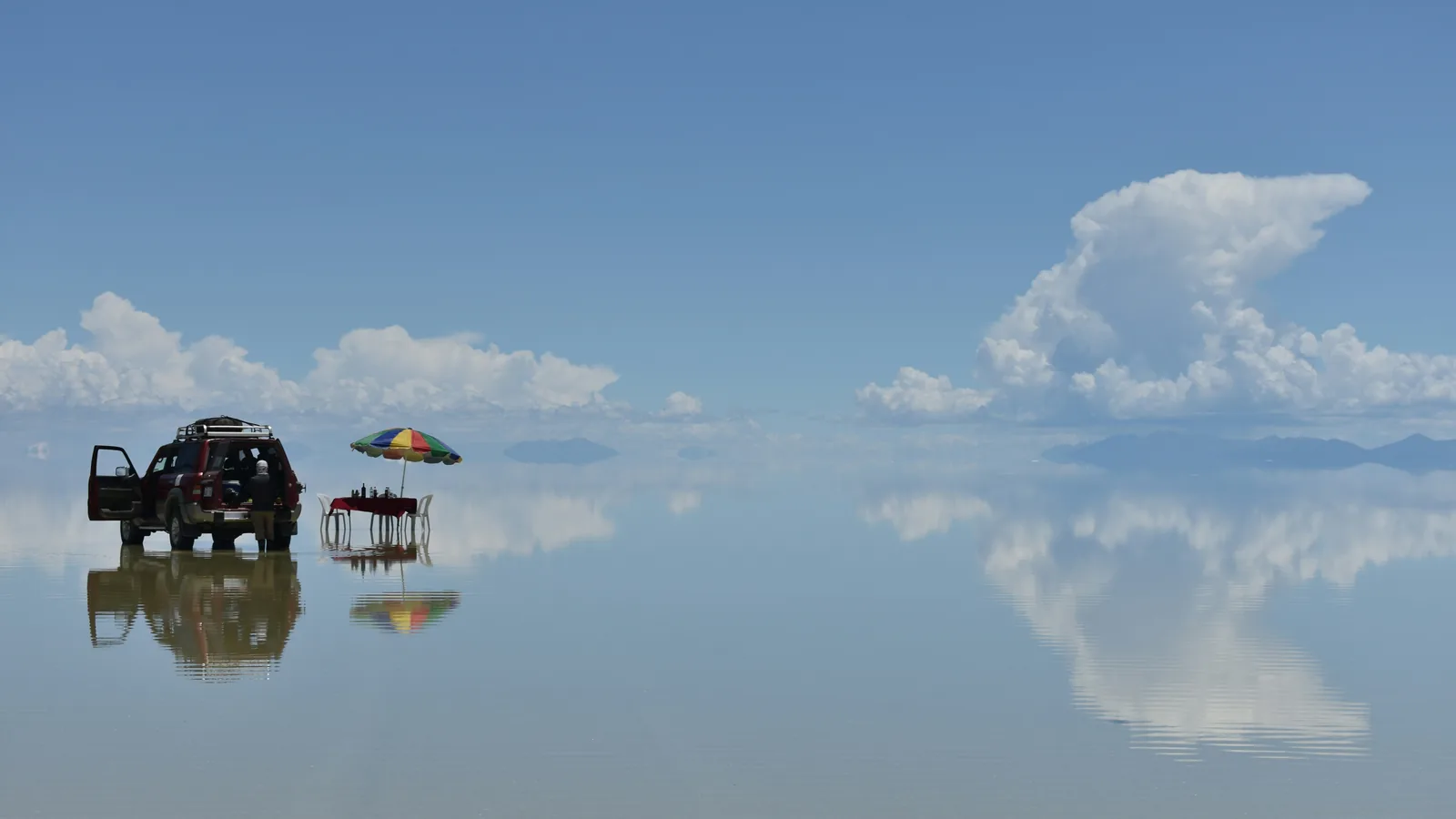
The Salar de Uyuni covers about 10,582 square kilometers of salt in southwestern Bolivia, at around 3,650 meters above sea level, and a thin layer of rain turns it into the largest natural mirror on Earth.

Know before you go

Salar de Uyuni at a glance

Local time…
Weather now · Uyuni…
Exchange rate…
CurrencyBoliviano (BOB)
LanguageSpanish, plus Quechua, Aymara and other indigenous languages
PlugsTypes A and C, 230 V
DrivingOn the right
Best timeAround January for the mirror, May to October for dry white salt

Facts last checked in November 2026. Altitude, rain and road conditions change what a tour can do, and the mirror is not guaranteed. Entry rules, prices and conditions change, so confirm visas and safety details with the official government sources before you travel. Weather: MET Norway. Exchange rates: ExchangeRate-API.

The story

A salt desert that is almost perfectly flat

The Salar de Uyuni is the largest salt flat in the world, covering about 10,582 square kilometers in the Potosí Department of southwestern Bolivia, near the crest of the Andes. Wikipedia puts its elevation at about 3,656 meters. It formed as a chain of prehistoric lakes dried up, and the salt crust they left behind is so flat that the average elevation varies by less than one meter across the whole area.

When rain covers the crust with a thin layer of still water, the flat becomes a giant mirror that reflects the sky and anything standing on it. In the dry season the surface is white, hard and cracked into hexagonal patterns. Beneath the crust lies a brine that is rich in lithium, and Wikipedia says Bolivia holds about 22 per cent of the world’s known lithium resources, most of them in the Salar.

10,582 km²area of the salt flat
<1 maverage elevation variation
≈3,656 melevation above sea level

From our Letsa Atlas Short · Watch on YouTube

Practical guide

Plan your Salar de Uyuni trip

Check before you go: entry rules depend on your passport, so check the official Bolivian requirements for your nationality before you book. The mirror depends on recent rain and is never guaranteed, the altitude is high, and tour quality varies a lot, so choose your operator with care. We have a longer guide with a 3-day plan.

When to go

  • Wikivoyage says flooding mostly happens in January, when the flat turns into a mirror, and that after the water evaporates, honeycomb-like polygons cover the surface. Rain outside January is rare, and May to October is the dry season. Daytime temperatures peak at about 21 °C from November to January, and nights are cold all year, from about −9 to 5 °C.

Getting there

  • Most tours start in the town of Uyuni, which has a small airport with flights from La Paz and other Bolivian cities, a railway line and long-distance buses. Wikivoyage lists 12 to 15 hours by bus from La Paz and 3 to 4 hours from Potosí. Check current flights, trains and timetables, because they change.

Two places to see first

  • Incahuasi Island, a rocky outcrop in the middle of the flat covered in giant cacti, and the train cemetery a few kilometers outside Uyuni town, where old locomotives from the mining era stand rusting. Tours usually stop at both.

Safety and respect

  • Take a guided tour, because the flat is hard to navigate without local knowledge, and choose an operator by reviews, not only by price. Allow time to adjust to the altitude, wear layers and strong sun protection, and carry plenty of water. Do not walk into the desert on your own.

The photo above shows a vehicle and a table on the mirror-like surface of the Salar de Uyuni. We checked on November 16, 2026. Prices, timetables and conditions change, so confirm them with official sources before you reserve.

Want the full picture? Read our complete Salar de Uyuni travel guide: how the salt flat formed, the mirror season, lithium and satellites, wildlife, tours and prices, altitude, safety and a 3-day plan. For the country, see our Bolivia guide.
Where to stay

Find a place to stay

Uyuni town is the practical base: most tours start there, it has the airport, railway and bus links, and a night before and after a tour is usually enough. Some visitors choose a salt hotel near the flat for the setting. Compare prices and reviews, and check the cancellation terms before you reserve.

See stays in Uyuni on Booking.com →

Some links on this page are affiliate links. If you book through them, Letsa Atlas may earn a small commission at no extra cost to you.

Things to do

Tours and activities

Compare one-day and multi-day Salar de Uyuni tours, sunrise and sunset trips and onward routes to the lagoons or San Pedro de Atacama, with reviews and free-cancellation options.

Find Salar de Uyuni tours on Viator →Compare on GetYourGuide →

Travel insurance. Medical care abroad can be expensive, and high altitude and long road transfers add risk on a trip like this, so many travellers buy cover before they leave. One option is SafetyWing Nomad Insurance. Read the policy wording to see what it covers, including altitude and organised tours, before you buy.

Sources checked November 16, 2026: Wikipedia: Salar de Uyuni · Wikivoyage: Salar de Uyuni · Wikipedia: Uyuni · Wikivoyage: Uyuni