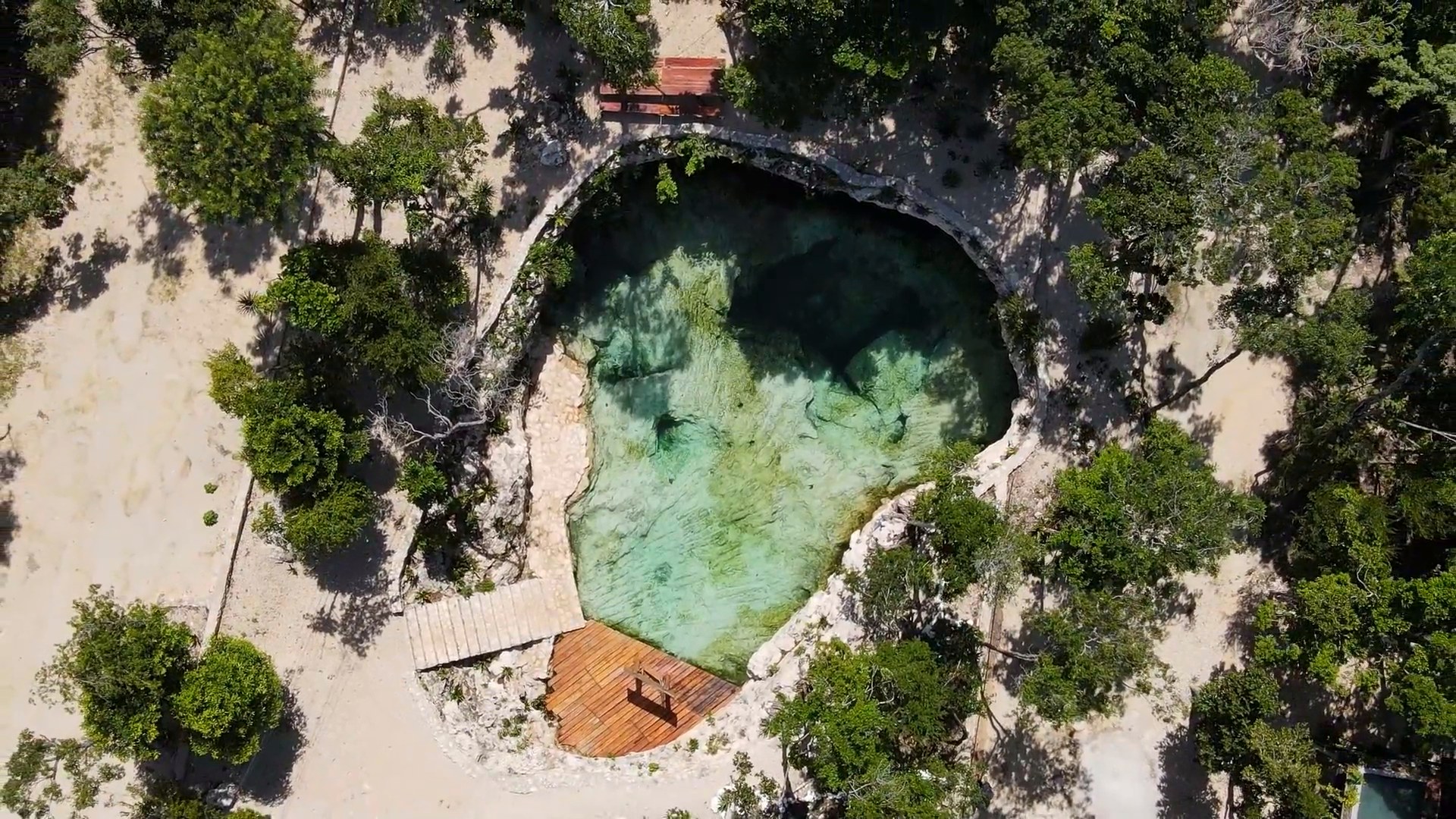
A practical guide to swimming in the natural sinkholes of the Yucatán Peninsula: what a cenote is, the best ones around Tulum, Valladolid (Yucatán, Mexico) and Chichén Itzá, the etiquette and safety rules, and the crater ring that runs underneath them.
A cenote is a natural pit or sinkhole that forms when limestone bedrock collapses and exposes the groundwater below. The word comes from the Yucatec Maya tsʼonoʼot, used for any place where you can reach groundwater. The Yucatán Peninsula is a flat limestone shelf with almost no surface rivers, so this hidden water has long been what people lived on, and today it is also what visitors swim in.
Nobody knows the exact number of cenotes. The estimates run from at least 6,000 to about 10,000 on the peninsula. Not all of them are open to visitors, and they come in very different shapes:
The water is usually cool, clear and fresh. Some flooded cave systems around Tulum have been explored for hundreds of kilometers, which gives you an idea of how much is hidden under the jungle floor.
Our 18-second Short about the cenotes is below, and our shorter Yucatán Cenotes guide has the quick version of the planning basics.
The Chicxulub crater lies beneath the northern Yucatán Peninsula. It was left by an asteroid about 10 kilometers wide that struck about 66 million years ago, and it is widely accepted as the main cause of the extinction that wiped out all non-avian dinosaurs. The crater is estimated at about 180 to 200 kilometers across and lies buried roughly one kilometer under younger rock, so you cannot see it from the ground.
What you can see is the cenotes. Clusters of them line up along the inner rim of the crater, at a radius of about 70 to 85 kilometers from its center. Researchers first noticed the ring in satellite images, and it matched a ring that geophysicist Glen Penfield had mapped from gravity and magnetic data. Rock weakened by the impact is thought to help explain why the ground collapses along that line, although the exact mechanism is still studied.
That is the idea behind the Short: you can float in a pool that sits on the edge of a crater from the day the dinosaurs died. Keep it in mind as a good story, not a place on a map. There is no sign saying you are crossing the rim.
The list below comes from the cenotes that travel writers and official sources keep naming. Check each cenote's own page for hours and current rules, because they change.
This is Valladolid in the state of Yucatán, Mexico, on the road toward Chichén Itzá and Mérida, not the city of the same name in Spain.
Cenote Azul, about 3 miles south of Bacalar, is about 300 feet deep. It is better suited to capable swimmers, though you can snorkel in the shallows.
Cenotes are small, fragile freshwater systems, and for the Maya they were sacred. The Maya believed cenotes were portals to Xibalba, the underworld, and homes of the rain god Chaac. Visitors are guests, and most sites have simple rules.
For most visitors a cenote is a swim, with a life jacket if needed. The water is deep and often cold, steps and platforms get slippery, and the floor can drop away quickly. Wear water shoes, never dive in headfirst, and only jump where staff say it is allowed.
Diving is a separate world. Cavern diving keeps natural light in view the whole time, while cave diving goes beyond the point where daylight reaches and requires special equipment and certification. The halocline, where fresh water meets salt water, can blur your vision until you reach a more uniform layer. Divers need a briefing, experience and buoyancy adjustment for fresh water. If you are not certified, a snorkel tour in a cavern gives you a taste of the underground world without the risk. Do not go beyond the daylight zone unless you are certified and with a guide.
Cenotes are also part of protected underwater cultural heritage. Human remains and ceremonial objects were left in some of them, and the UNESCO Convention on the Protection of the Underwater Cultural Heritage covers this. Never remove anything from a cenote.
Season. The dry season, roughly November to April, is generally the easiest time to visit. Summer is hotter and wetter and falls in hurricane season. Heavy rain can make the water murky, and some cave cenotes close when levels are high. Whatever the month, go early. The popular cenotes are busiest around midday, and the Sacred Cenote is easier to see if you arrive 15 to 30 minutes before the gates open to beat the tour buses.
Getting around. Valladolid (in Yucatán state, Mexico), Mérida and Tulum are the usual bases, and each has many cenotes within a short drive. A rental car gives the most freedom. Taxis, colectivos (shared minibuses) and organised tours also reach the popular cenotes. For example, you can reach Dos Ojos by colectivo from Tulum or Playa del Carmen, and walk the last stretch on a dirt road. Zací is walkable from the main square in Valladolid.
These are our own suggestions, built from the distances above, not official itineraries.
Do not try to do more than two or three cenotes a day. The best ones are worth the time, and the drive between them takes longer than people expect.
A cenote is a natural pit or sinkhole that forms when limestone bedrock collapses and exposes groundwater. The word comes from the Yucatec Maya word tsʼonoʼot, used for any place with accessible groundwater.
Nobody has an exact count. Estimates range from at least 6,000 to about 10,000 cenotes on the Yucatán Peninsula, and only a fraction are open to visitors.
No. Swimming there is prohibited, but you can see it from above. If you want to swim near Chichén Itzá, Ik Kil and Yokdzonot are the usual choices.
Cenotes are small freshwater systems, and chemicals from sunscreen and repellent wash off into the water. Many cenotes, such as Gran Cenote near Tulum, ask you to shower first and not to use sunscreen in the water. A rash guard is a good alternative.
Not for the shallow, popular cenotes, but the water is deep and the floor can drop away. Wear the life jacket if the cenote requires it, as Zací in Valladolid does, and stay within the area staff say is open.
Snorkeling and cavern diving, where daylight stays visible, are possible with a guide. Cave diving goes beyond the daylight zone and requires special equipment and certification. Do not go past the daylight zone unless you are certified and with a guide.
The dry season, roughly November to April, is generally the easiest time. Heavy rain can make the water murky, and some cave cenotes close when water levels are high. Go early in the morning to avoid the crowds.
It helps, but it is not required. Many cenotes can be reached by colectivo, taxi or organised tour. Zací is in the center of Valladolid, so you can walk to it from the main square.
Tulum is a good base for the cenotes along the coast. Compare prices and reviews, and check the cancellation terms before you reserve.
See stays in Tulum on Booking.com →
Some links on this page are affiliate links. If you book through them, Letsa Atlas may earn a small commission at no extra cost to you.
We checked this guide on November 8, 2026. Rules, opening hours and prices differ for every cenote and change often, and some cave cenotes close when water levels are high. Confirm details with the cenote or an official source before you go.
Sources checked November 8, 2026: Wikipedia: Cenote · Wikipedia: Sacred Cenote · Wikipedia: Chicxulub crater · Lonely Planet: Cenotes of Mexico's Yucatán Peninsula