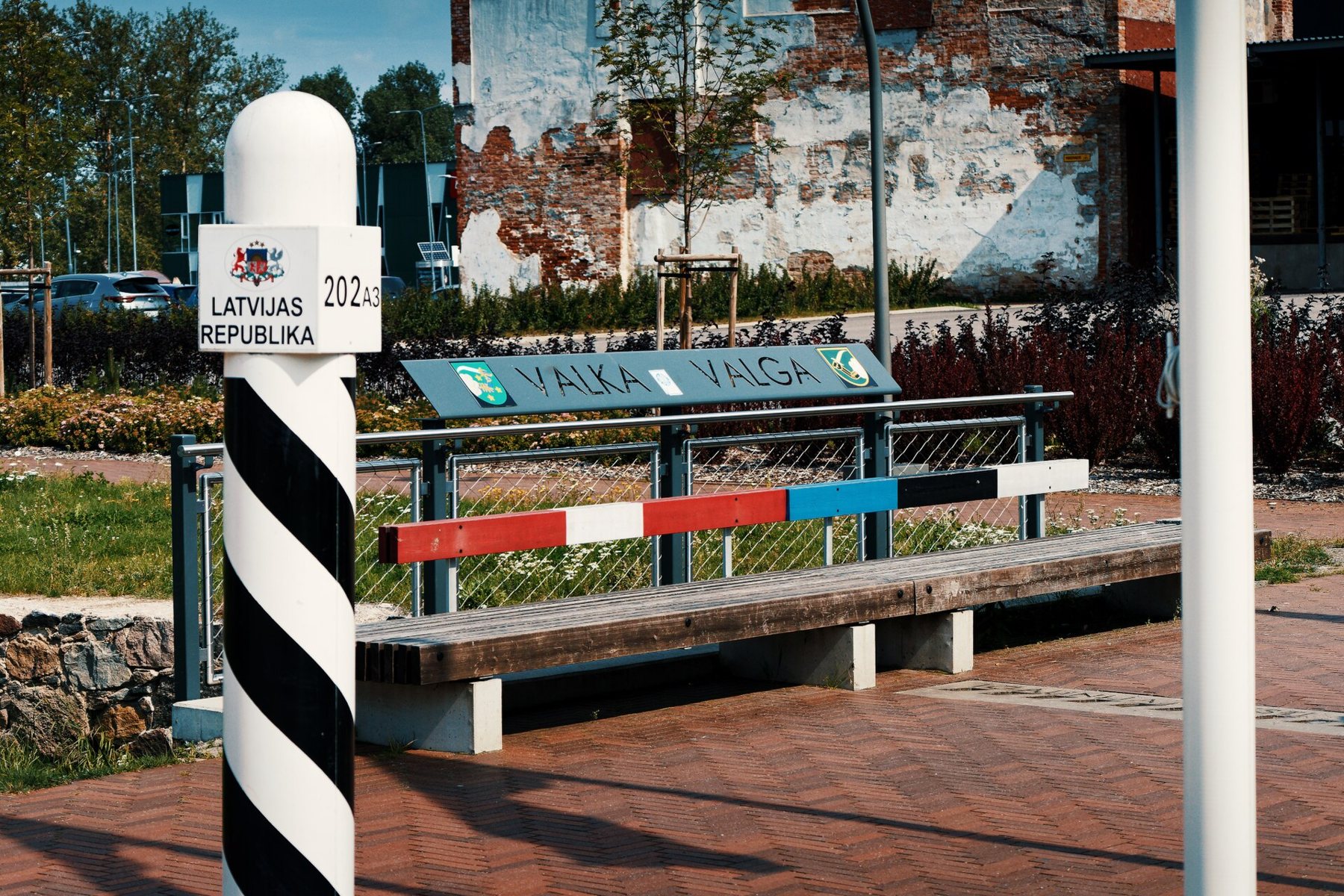
A practical guide to the twin town of Valga and Valka: how the border ended up in the middle of it, how to get there, how to cross on foot and what to see on both sides.
Valga in Estonia and Valka in Latvia are twin towns that were one town until 1920. On 1 July 1920, the British envoy Colonel S. G. Tallents settled the border between Estonia and Latvia, and the town was divided into Estonian and Latvian areas on the basis of ethnicity. The motto of Valga today is “1 linn, 2 riiki”, one city, two countries.
For a visitor, it is an easy and unusual stop. You can stand on the border in the town center and cross on foot without any checks. The real planning questions are how to reach the town by rail or road, and how to make the most of a short visit.
Our short video about the town is below. For the quick version of this page, see our Valga–Valka travel guide.
Valga was first mentioned in 1286 in the credit register of the city of Riga. Its German name is Walk and its Latvian name is Valka. Until 1920 the two halves were one town, and the arrival of the railway in 1889, when the Tartu–Valga line opened on 22 July, made it a junction between the Estonian and Latvian lands.
When Estonia and Latvia became independent states, their claims overlapped here. The dispute was settled on 1 July 1920 by British envoy Colonel S. G. Tallents, who divided the city into Estonian and Latvian areas on the basis of ethnicity. Our video describes the line as running along a small stream through the railway town. After that, Valga became a county centre in 1921, and Valka became a Latvian border town.
On 21 December 2007, the border crossing points between the towns were removed and the roads and fences between the two countries were opened, when both Estonia and Latvia joined the Schengen Agreement. Today you can walk from one country to the other in the town center, and the only sign is the border marker.
Carry ID, since rules for your own passport can change, and note that both Estonia and Latvia use the euro, so you do not need to change money to cross. Check the local situation before you travel, because border rules can be changed quickly in special circumstances.
Valga sits at a junction of roads and railways. Its station opened in 1889 and the Tartu–Valga line officially opened on 22 July of that year. Elron runs trains on the route Tallinn–Tartu–Valga. The distance from Valga is 89 kilometers to Tartu, 144 kilometers to Pärnu, 245 kilometers to Tallinn and 175 kilometers to Riga.
The line between Tartu and Valga was closed in April 2008 for repairs and reopened in January 2010. As of 2025, city bus no. 3 connects Valga and Valka three times a day, departing from the Valga train station, which is the easiest way to cross if you do not want to walk. Timetables change, so check before you go.
The main sights are small and easy to combine in a short visit.
Valga also has a town park, Linnapark, and Vabaduse Street, the main street. Because Valka is a few minutes away on foot, you can see both in a morning.
Valga had 12,010 residents in the 2021 census, down from a peak of about 18,500 in 1979. In 2021, Estonians were 59.2 percent of residents, Russians 26.3 percent, Latvians 5.65 percent and Ukrainians 3.02 percent. You will hear several languages on the street, and English is usually enough for simple needs.
The local newspapers include Valgamaalane, published since 1944, and Walk, a Russian-language paper that has existed since 2003. That mix is a reminder that the border did not erase the shared history of the two halves.
Valga was a founding member of the City Twins Association, founded in Imatra, Finland, on 13 December 2006. Other members include Narva, Görlitz and Vejle. The idea is that towns divided by a border can cooperate rather than compete.
That is the story to look for when you visit: two town halls, two sets of services and one connected street grid. The twin-town label is not only a slogan, because people really do move between the two halves in daily life.
The railway explains why a border dispute landed in this particular place. Valga sits at a junction of roads and railways, and the station that opened in 1889 made it a hub long before 1920. During the Cold War the town was also home to an air base. Passenger trains on the Valga–Võru–Koidula line stopped in 2001, and freight on that line was cut back significantly after Russia’s invasion of Ukraine, so the rail map today is smaller than it once was.
Even so, arriving by train is still the best way to understand the town. You step off at the station that is the heart of the story, and the border markers are a short walk away.
This is our own suggestion, not an official itinerary.
Valga is a small town, so prices are generally lower than in the capitals, and you can see it in a few hours. Check the bus timetable if you plan to use bus no. 3, and bring ID. If you want to stay overnight, a room on either side puts both towns on your doorstep.
The town can be visited throughout the year. The walk between the two halves is outdoors, so late spring through early autumn is more comfortable, and winter can be cold. Check the local events calendar if you want to see festivals or cross-border events.
On 1 July 1920, Colonel S. G. Tallents settled the Estonia–Latvia border and divided the town into Estonian and Latvian areas on the basis of ethnicity.
Yes. Border checkpoints were removed on 21 December 2007, when both countries joined the Schengen Agreement.
By train on the Tallinn–Tartu–Valga route run by Elron, or by road. Tartu is 89 km away and Riga 175 km.
As of 2025, city bus no. 3 connects the two towns three times a day from Valga train station.
12,010 in the 2021 census.
“1 linn, 2 riiki”, meaning one city, two countries.
A few hours is enough to see both sides, and many people stop on the way between Tartu and Riga.
An association founded in 2006 by towns divided by a border. Valga was a founding member.
Valga is small, so most visitors come for a day or an overnight stop on the way between Tartu and Riga. A room in Valga or Valka puts both towns on your doorstep. Compare prices and reviews, and check the cancellation terms before you reserve.
See stays in Valga on Booking.com →
Some links on this page are affiliate links. If you book through them, Letsa Atlas may earn a small commission at no extra cost to you.
We checked this guide on November 10, 2026. Timetables, bus routes and opening hours change, so confirm them with local sources before you go. Confirm details with official sources before you go.
Sources checked November 10, 2026: Wikipedia: Valga, Estonia · Wikipedia: Valka