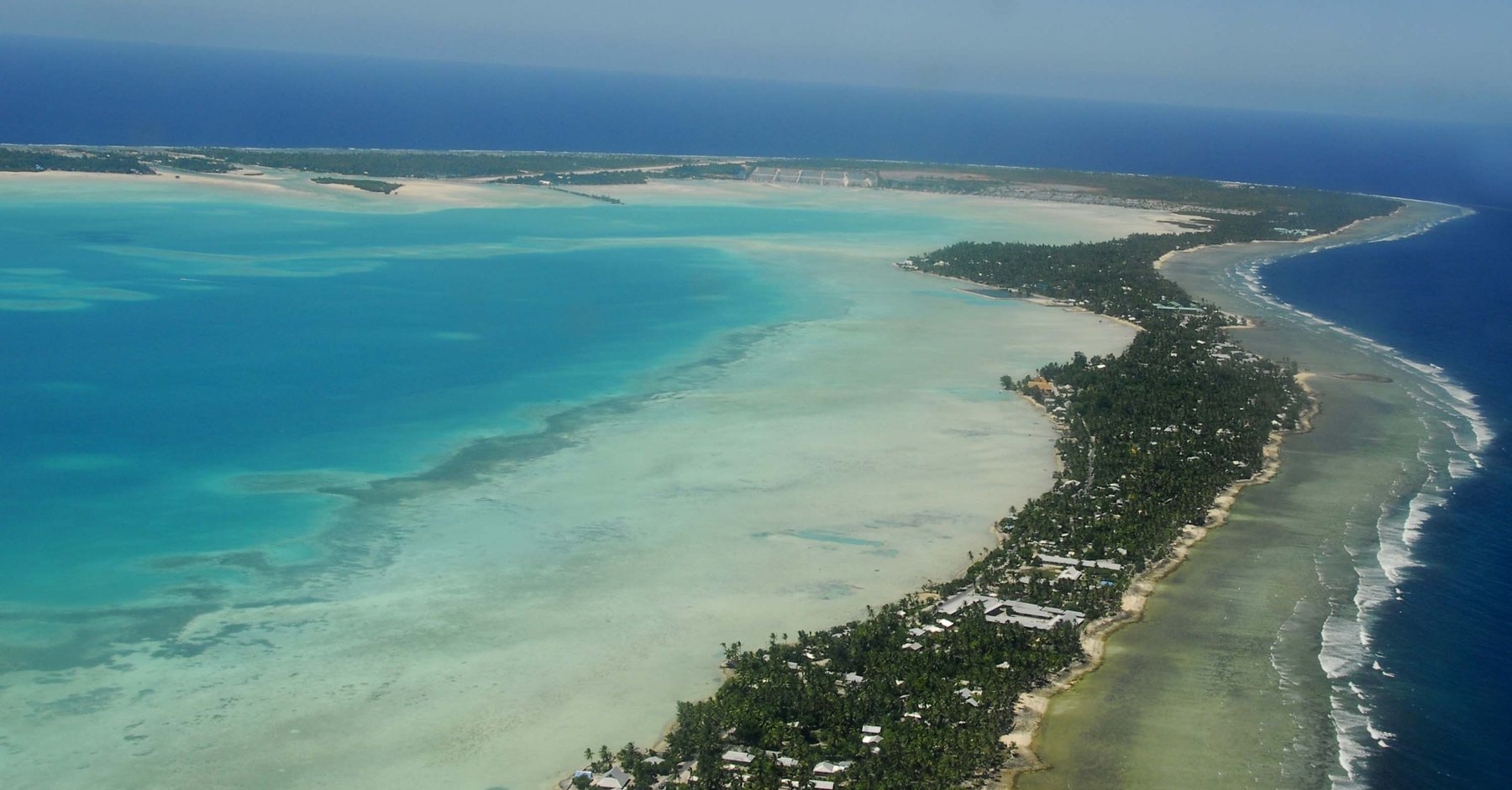
A practical guide to Kiribati: how a country of atolls spread over millions of square kilometers of ocean ended up with the most advanced time zone on Earth, and what to plan if you want to visit.
Kiribati is an island country in the central Pacific with 32 atolls and other islands plus one raised coral island, Banaba. It has about 811 square kilometers of land spread across roughly 3.44 million square kilometers of ocean, and the islands straddle both the equator and the 180th meridian.
It is the country in our video about a nation that changed its own calendar day. For a traveller it is a remote, low, warm place where the sea, the lagoon and community life matter more than a list of sights.
For the quick version of this page, see our Kiribati travel guide.
The International Date Line was moved east in 1995 to encompass the Line Islands, so the country is no longer split across it. Before that, parts of Kiribati were on different calendar days. The southern Line Islands are now in UTC+14, the most advanced time zone on Earth.
The result is that Kiribati has some of the earliest sunrises of each new day anywhere. That is why the island of Kiritimati is often mentioned in connection with new year celebrations, and it is the source of the idea in our video.
Kiribati has 32 atolls and other islands plus one raised coral island, Banaba. The land area is about 811 square kilometers, but the country's ocean area is about 3.44 million square kilometers. The islands are grouped in three main chains, the Gilbert, Phoenix and Line Islands, and they are very far apart.
The capital is Tarawa, where more than half of the population lives. The Phoenix Islands are part of one of the largest marine protected areas on Earth.
The I-Kiribati are a Micronesian people, and 95.7 percent of residents identified as Gilbertese at the 2020 census. Christianity is the major religion at 96.2 percent, with Catholics at 58.9 percent. The official languages are Gilbertese and English, but English is used little outside Tarawa, so a few Gilbertese greetings will help. The currency is the Australian dollar.
Population figures differ by source: 119,438 in the 2024 census figure and 119,940 in the November 2020 census. There is a large diaspora, the biggest in New Zealand.
Kiribati was a British protectorate from 1892 and became a crown colony in 1916. It gained independence on 12 July 1979, and the Treaty of Tarawa followed on 20 September 1979. It joined the United Nations in 1999.
The economy depends on fisheries, subsistence agriculture, copra exports, foreign fishing licence fees, aid and remittances. Phosphate mining on Banaba was exhausted before independence.
The climate is tropical. Kiribati generally does not experience cyclones, though cyclones nearby can have effects. As a low-lying atoll nation, it is highly vulnerable to sea-level rise and other climate impacts, including tsunamis.
A rise of about 50 centimeters by 2100 is projected, and two uninhabited islets disappeared underwater in 1999. Many I-Kiribati talk about this directly, and the government has treated climate change as the main long-term threat.
Bonriki International Airport on Tarawa is the hub for domestic flights by Air Kiribati and Coral Sun Airways. Cassidy International Airport on Kiritimati has international service by Fiji Airways, which flies Nadi to Kiritimati and on to Honolulu.
We have not verified the current schedules, so check them directly. Flights are infrequent and the islands are far apart, so build slack into any plan, and do not book tight connections. Entry rules depend on your passport.
There are few places to stay, most of them on Tarawa. Book well ahead and confirm directly. Almost everything is imported, so expect higher prices and limited choice, and bring any medication and sun protection you need. Bring Australian dollars and check what cards work.
Kiritimati, also known as Christmas Island, is in the Line Islands and is the island most often linked with being among the first places in the world to see a new day. It has Cassidy International Airport, with Fiji Airways flights from Nadi that continue to Honolulu.
Because it is in the UTC+14 zone, a trip between Kiritimati and Honolulu is unusual: the calendar date can change in a way that surprises first-time travellers, so double-check dates on tickets and bookings.
The economy depends on fisheries, subsistence agriculture, copra exports, licence fees paid by foreign fishing fleets, aid and remittances. Phosphate mining on Banaba was exhausted before independence. Much of the population lives on Tarawa, where jobs and services are concentrated.
Because the islands are small and far apart, almost every manufactured good is imported. For a visitor this means that shops are simple and that bringing what you need is the safest approach.
Daily life centres on family, church and the village meeting house, the maneaba. Gatherings, songs and dance are an important part of community events, and visitors are usually welcome when invited. Ask before joining, accept hospitality with thanks and follow the lead of your hosts.
Dress modestly, especially away from the main road on Tarawa, and ask before photographing people. A few words of Gilbertese, such as the greeting mauri, are warmly received.
The lagoon and reef are central to food and daily life. Currents can be strong at channels and passes, and tides matter, so ask local people where it is safe to swim or snorkel. Do not walk on live coral, and respect any fishing restrictions.
Medical facilities are limited, so bring a basic medical kit and check your travel insurance for evacuation cover before you go.
Kiribati rewards travellers who like quiet places and community life.
This is our own suggestion, not an official itinerary.
Many people here live with the question of the sea every day. Ask rather than assume, listen to what people say about their own islands, and avoid treating the country only as a symbol. Follow local advice about the lagoon and the reef, and do not collect shells or coral.
The line was moved east in 1995 to encompass the Line Islands, so the whole country sits on one side of it.
The southern Line Islands are in UTC+14, the most advanced on Earth.
About 811 square kilometers of land, spread across roughly 3.44 million square kilometers of ocean.
Tarawa.
The Australian dollar.
By air. Bonriki on Tarawa has domestic flights, and Fiji Airways flies Nadi to Kiritimati and on to Honolulu.
Gilbertese and English, though English is used little outside Tarawa.
About 50 cm of rise is projected by 2100, and two uninhabited islets disappeared in 1999.
Kiribati has few places to stay. Book well ahead, confirm directly and expect limited choice, especially outside Tarawa. Compare prices and reviews, and check the cancellation terms before you reserve.
See stays in Tarawa on Booking.com →
Some links on this page are affiliate links. If you book through them, Letsa Atlas may earn a small commission at no extra cost to you.
We checked this guide on November 10, 2026. Flight schedules, entry rules and prices change, so confirm them with airlines and official sources before you go. Confirm details with official sources before you go.
Sources checked November 10, 2026: Wikipedia: Kiribati