A practical guide to Iceland: how the seasons change what you can do, the Golden Circle and the Ring Road, northern lights, whales and puffins, the Blue Lagoon, what it costs and how to travel safely.
Iceland is a volcanic island in the North Atlantic with about 395,000 people and an area of 103,125 square kilometers. It receives far more visitors than it has residents: in 2024 foreign visitors through Keflavík Airport numbered about 2.26 million. The country is known for geysers, waterfalls, glaciers, hot springs and a landscape shaped by about 30 active volcanic systems.
Summer, from June to August, is the busiest season and the easiest for driving and the highlands. Winter is the best time for the northern lights and ice caves. Spring and autumn are quieter and cheaper. There is no wrong season, only a different Iceland in each.
Our 18-second Short about Iceland is below. The rest of this page is the planning detail behind it. For the quick version, see our Iceland travel guide.
Iceland's light changes more than its temperatures. In Reykjavík you get about 20 to 21 hours of daylight around the June solstice and only 4 to 5 hours in December, when the sun rises around 11:30 and sets around 15:30. That shapes everything you can do.
| Season | Daylight | Typical temperature | Best for |
|---|---|---|---|
| Winter (Dec–Feb) | 4–5 hours in December, growing quickly | About -5 to 2 °C | Northern lights, ice caves, snowy scenery, lower prices. Some areas, including the highlands and the Westfjords, may be inaccessible. |
| Spring (Mar–May) | 13–14 hours in early April, about 20 in late May | About 3 to 10 °C | Late February to late March is described as the best window for the northern lights. Puffins return in late April and May. |
| Summer (Jun–Aug) | 20–21 hours around the solstice, midnight sun | About 10 to 15 °C, sometimes 20 °C | Driving the Ring Road, the highlands, whale watching and puffins. Busiest and most expensive. |
| Autumn (Sep–Nov) | From about 14 hours in early September to 8–9 in late October | About 5 to 10 °C, dropping toward freezing | Northern lights return in September. Fewer crowds and lower prices. |
The northern lights season runs from September to April, when the nights are dark enough. One guide names October to November and late February to late March as the best periods. November is described as the clearest month, while September and October are the cloudiest. December has the longest nights but few strong geomagnetic storms. Even in good months you need clear skies, so give yourself several nights.
The midnight sun is strongest around the summer solstice, typically 20 to 22 June. Summer is also the season for the highlands. F-roads, which are four-wheel-drive only, usually open only in summer, and July and August are the months to reach the interior.
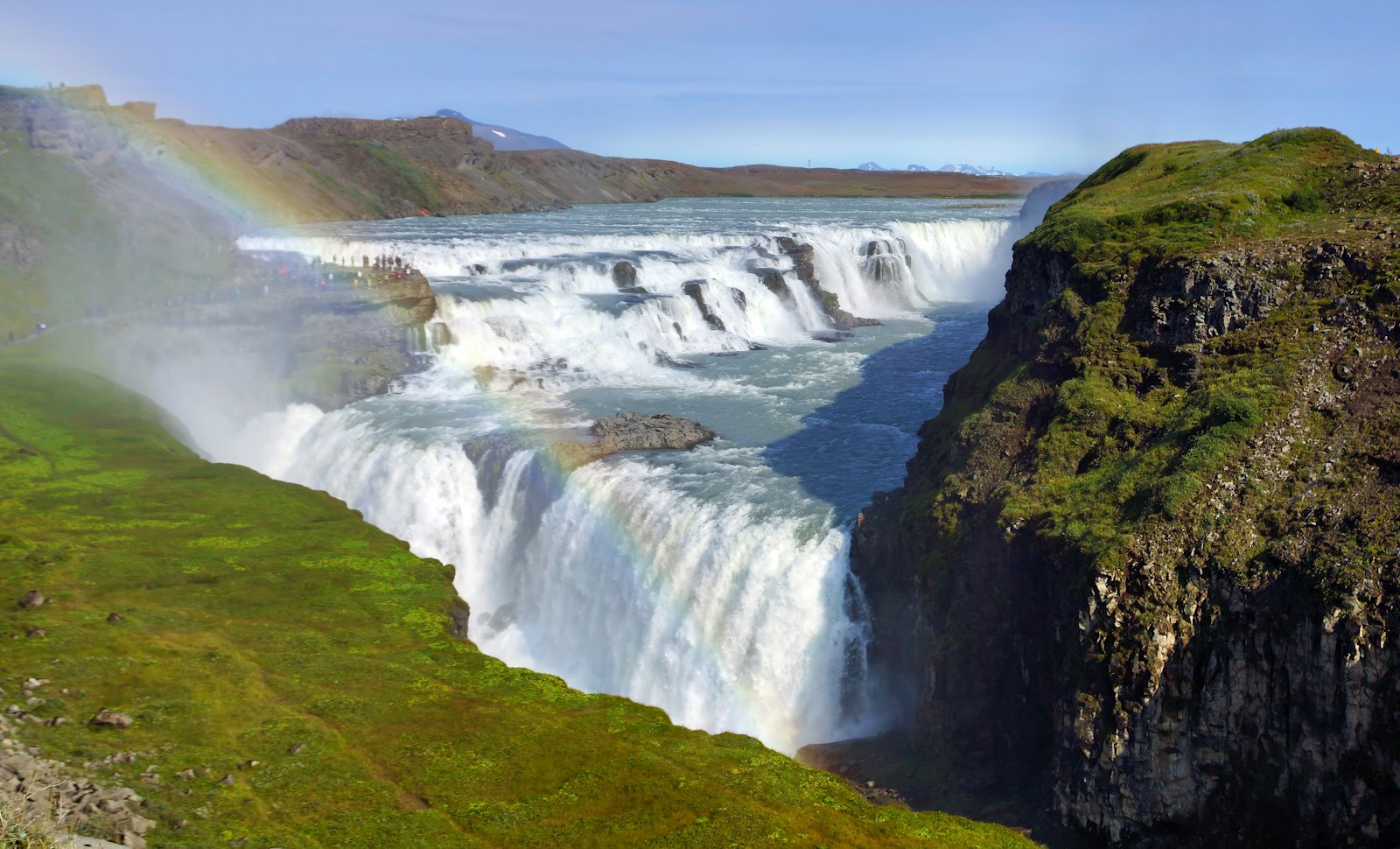
The Golden Circle is a loop of about 300 kilometers from Reykjavík into the southern uplands and back. The term was developed by Iceland's tourism board to promote travel to the country, and it works well as a first day because the sights are close together. There are three main stops:
Other common stops on the loop include the Kerið volcanic crater, the Brúarfoss and Faxi waterfalls, the town of Hveragerði, Skálholt cathedral and the Nesjavellir and Hellisheiði geothermal power plants. You can do the whole loop in a day by car or on a tour from Reykjavík, but it is better with an early start, because the sights get busy by midday.
The Ring Road, Route 1, runs 1,332 kilometers around the island and was completed in 1974. Most visitors do part of it. The stretch east of Reykjavík is the most popular. In the same 2014 survey, Vík and Skógar were each visited by more than 40 percent of summer tourists, and the Jökulsárlón glacier lagoon and Skaftafell by about 40 percent each. Further around the ring, Akureyri and Mývatn in the north were visited by about a third.
The whole ring takes at least a week if you want to stop. If you have less time, a round trip from Reykjavík along the south coast to Jökulsárlón is a better use of days than rushing around the full loop. Vatnajökull, Europe's largest glacier, anchors this part of the country.
Check the road and weather forecast every day. Conditions can change fast, and a closed road can add hours to a trip. Speed limits are 90 km/h on paved roads and 80 km/h on unpaved roads, and sheep and single-lane bridges are common.
Iceland's activities follow the seasons, so it helps to match them to your dates.
Iceland is expensive, comparable to Norway or Switzerland according to travel guides. Cards are accepted almost everywhere, tipping is not customary, and the currency is the Icelandic króna. Bónus, Netto and Krónan are the cheaper grocery chains, and cooking some of your own meals is the easiest way to keep a budget.
Iceland is part of the Schengen Area but not of the EU, so every traveler, including EU citizens, goes through customs on arrival. Entry rules, including any pre-travel authorization required for Schengen travel, change, so check official government sites before you book. The Blue Lagoon is cheapest in April, according to one booking analysis, and midweek evenings are cheaper than weekend afternoons.
Keflavík International Airport is the main hub, about 49 kilometers from Reykjavík, and a FlyBus connects it to the city. Icelandair passengers flying between the Americas and Europe can take a stopover of one to seven nights. A ferry also runs from Denmark to Seyðisfjörður in the east.
A car is the most flexible option, and two-wheel-drive rentals work for the main roads, but reserve early. F-roads are four-wheel-drive only and mostly closed from October to mid-June, and off-road driving is not allowed. Buses connect towns, and interior tours generally run in summer only. If you are not used to winter driving, a guided tour is safer from November to March.
The emergency number is 112. The official Safetravel.is site says conditions can change fast, so check them before and during your trip, and submit a travel plan that a trusted person can act on if needed. The site also has pages on winter driving, Highland driving and hiking.
This is our own suggestion, built from the distances and seasons above, not an official itinerary. Adjust it to the season.
In winter, add two or three evenings for the northern lights, and always keep a spare day for road closures.
It depends on what you want. Summer, June to August, has the midnight sun and the easiest driving, and the highlands usually open in July. Winter has the northern lights and ice caves, and spring and autumn are quieter and cheaper.
The season runs from September to April, when the nights are dark enough. One guide names October to November and late February to late March as the best periods, and you still need clear skies, so plan several nights.
Four to five days is enough for Reykjavík, the Golden Circle and part of the south coast. Our suggestion for the Ring Road is at least a week.
Yes. Travel guides describe it as comparable to Norway or Switzerland. You can reduce costs with cheaper grocery chains such as Bónus, Netto and Krónan, and by traveling in spring or autumn.
Not for the main roads, where two-wheel-drive rentals work. F-roads are four-wheel-drive only and usually open only in summer, mostly closed from October to mid-June.
Travel guides describe crime as very low, but nature is the risk. Weather and road conditions change fast, so check conditions daily, keep away from glacier fronts, big waves and geothermal ground, and call 112 in an emergency.
It is one of the best-known places in Iceland and is open year-round. Book ahead for a specific time, since early afternoon is the busiest slot and evenings are quieter and cheaper.
Iceland is part of the Schengen Area, and rules depend on your passport. Check official government sites before booking, including any pre-travel authorization required for Schengen travel.
Reykjavík is the easiest base for the Golden Circle and the south coast. Compare prices and reviews, and check the cancellation terms before you reserve.
See stays in Reykjavík on Booking.com →
Some links on this page are affiliate links. If you book through them, Letsa Atlas may earn a small commission at no extra cost to you.
We checked this guide on November 8, 2026. Prices, opening hours, road conditions and volcanic activity change quickly in Iceland, and the northern lights, whales and puffins are never guaranteed. Confirm details with official sources before you go.
Sources checked November 8, 2026: Wikipedia: Iceland · Wikipedia: Golden Circle · Wikipedia: Tourism in Iceland · Guide to Iceland: Best time to visit · Safetravel.is