A practical guide to Canada: why it has over two million lakes and the longest coastline in the world, how the provinces and territories are organised, and how to plan a trip across a very large country.
Canada has over 2,000,000 lakes, 563 of them larger than 100 square kilometers, and the world's largest area of fresh water lakes. It also has the longest coastline of any country, at 243,042 kilometers, and the second-largest area at 9,984,670 square kilometers. The capital is Ottawa and the largest city is Toronto.
For a traveller, the main planning fact is scale. Canada is divided into 10 provinces and 3 territories, and the trip you plan depends on the region and season, so choose one or two areas instead of trying to cross the country.
For the quick version of this page, see our Canada travel guide. Our Atlas Index also lists the Canadian videos about the coastline and Thanksgiving.
Canada has over 2,000,000 lakes, and 563 are larger than 100 square kilometers. It has the world's largest area of fresh water lakes. A large part of the country was shaped by glaciers, which scoured the rock and left countless basins that filled with water, and the Canadian Shield and the Hudson Bay lowlands are especially full of lakes.
The Great Lakes, shared with the United States, feed the St. Lawrence River, where much of Canada's economic output is concentrated.
Canada's coastline, at 243,042 kilometers, is the longest of any country, because it includes the Arctic, Atlantic and Pacific coasts and a huge number of islands. Its longest international land border is with the United States, at 8,891 kilometers.
You can experience very different coasts in one trip: rugged Atlantic shores in the east, mild, rainy Pacific coast in British Columbia and Arctic coast in the north.
Canada has 10 provinces and 3 territories. English and French are the official languages, and the currency is the Canadian dollar. The 2021 census counted 36,991,981 people, and the 2026 estimate is about 41.8 million.
Services in French are common in Quebec and parts of other provinces, and a bilingual greeting is appreciated.
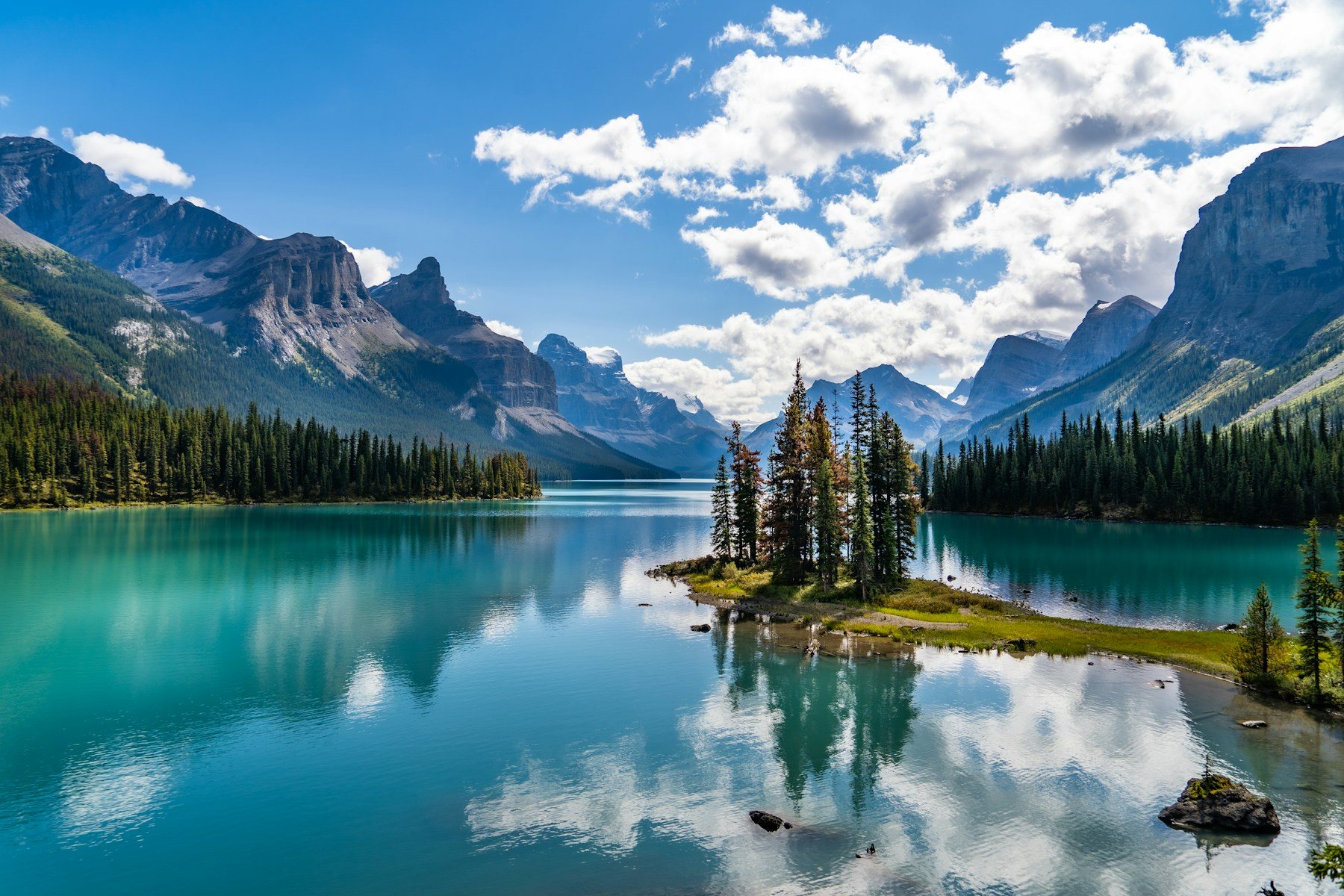
Banff National Park, established in 1885, is Canada's first national park, and Algonquin Provincial Park, established in 1893, is the oldest provincial park. The photo at the top of this page shows Maligne Lake in Jasper National Park, in the Canadian Rockies.
Popular parks have limited parking and sometimes require advance reservations for campsites, shuttles or timed entry, so check before you travel and arrive early in summer.
Winters are harsh in the interior and Prairie provinces, where temperatures can fall below -40 °C, while coastal British Columbia has a mild, rainy winter. Summer is the peak season for lakes and parks, autumn is good for colour in the east, and winter suits snow sports.
The country spans several time zones, from UTC-3.5 to UTC-7, so check local time when you plan long drives or flights.
Canada's Thanksgiving, celebrated in autumn, has older roots than many people expect. One early ceremony often cited was held by the explorer Martin Frobisher in 1578, decades before the Pilgrims' harvest feast of 1621 in what is now the United States. We cover this in a separate video and guide, and the details are a matter of historical interpretation.
Large airports such as Toronto, Vancouver and Montreal connect Canada with the world, and internal flights link the regions. We have not verified current schedules, so check with airlines. Driving is the usual way to reach parks and small towns, but distances are long and weather in winter can close roads.
Entry rules and visa or electronic authorisation requirements depend on your passport and change, so confirm them with official sources.
Cities such as Toronto, Montreal, Vancouver and Ottawa have the widest choice. Park towns fill quickly in summer, so book early. Cards are widely accepted, and tipping is customary in restaurants. Carry layers in every season, and keep an eye on the forecast for mountain and coastal trips.
Toronto is the largest city and a major gateway, Montreal is the centre of French-speaking Canada, Vancouver sits between the mountains and the Pacific, and Ottawa, the capital, is a compact city of museums and parliament buildings. Each city is a good base for a few days, with day trips to lakes, parks or small towns.
Public transport is good in the big cities, but outside them a car is usually needed.
Summer is the main season for lakes, hiking and road trips, with long days. Autumn brings colour in eastern forests and quieter parks, winter suits skiing, skating and northern lights in some regions, and spring is a shoulder season, when some trails and roads are still closed by snow or mud. Choose the season first, then the region.
Canadian food varies by region: seafood on the Atlantic and Pacific coasts, French-Canadian dishes in Quebec, maple syrup across the east and a growing mix of cuisines in big cities. Try local specialities, and look for farmers' markets in summer and autumn. Tipping 15 to 20 percent is customary in restaurants.
Choose a region and take your time.
These are our own suggestions, not official itineraries.
Canada's parks are home to bears, elk and other large animals. Keep your distance, never feed wildlife, store food as the park advises and follow ranger instructions. Lakes can be very cold even in summer, so swim only where it is safe, and in winter check ice conditions with locals before walking on frozen water.
Dress in layers, carry insect repellent in summer and sun protection at altitude. Plan long drives with breaks, since distances between towns can be large, and fill up fuel before leaving small towns. In remote areas, mobile coverage can be limited, so download maps and tell someone your route.
Respect Indigenous lands and cultures, ask before visiting communities and support Indigenous-led tours where available.
Check road and weather conditions before long drives, especially in the mountains and in winter, and keep an emergency kit in the car.
It has over 2,000,000 lakes and the world’s largest area of fresh water lakes.
243,042 kilometers, the longest of any country.
Ottawa.
10 provinces and 3 territories.
English and French.
The Canadian dollar.
Banff, established in 1885.
In the interior and Prairies, temperatures can fall below -40 °C in winter.
Choose a base in the region you plan to visit. Cities have the widest choice, and park areas fill up in summer, so book ahead. Compare prices and reviews, and check the cancellation terms before you reserve.
See stays in Ottawa on Booking.com →
Some links on this page are affiliate links. If you book through them, Letsa Atlas may earn a small commission at no extra cost to you.
We checked this guide on November 10, 2026. Entry rules, park fees, prices and transport schedules change, so confirm them with official sources before you go. Confirm details with official sources before you go.
Sources checked November 10, 2026: Wikipedia: Canada · Destination Canada