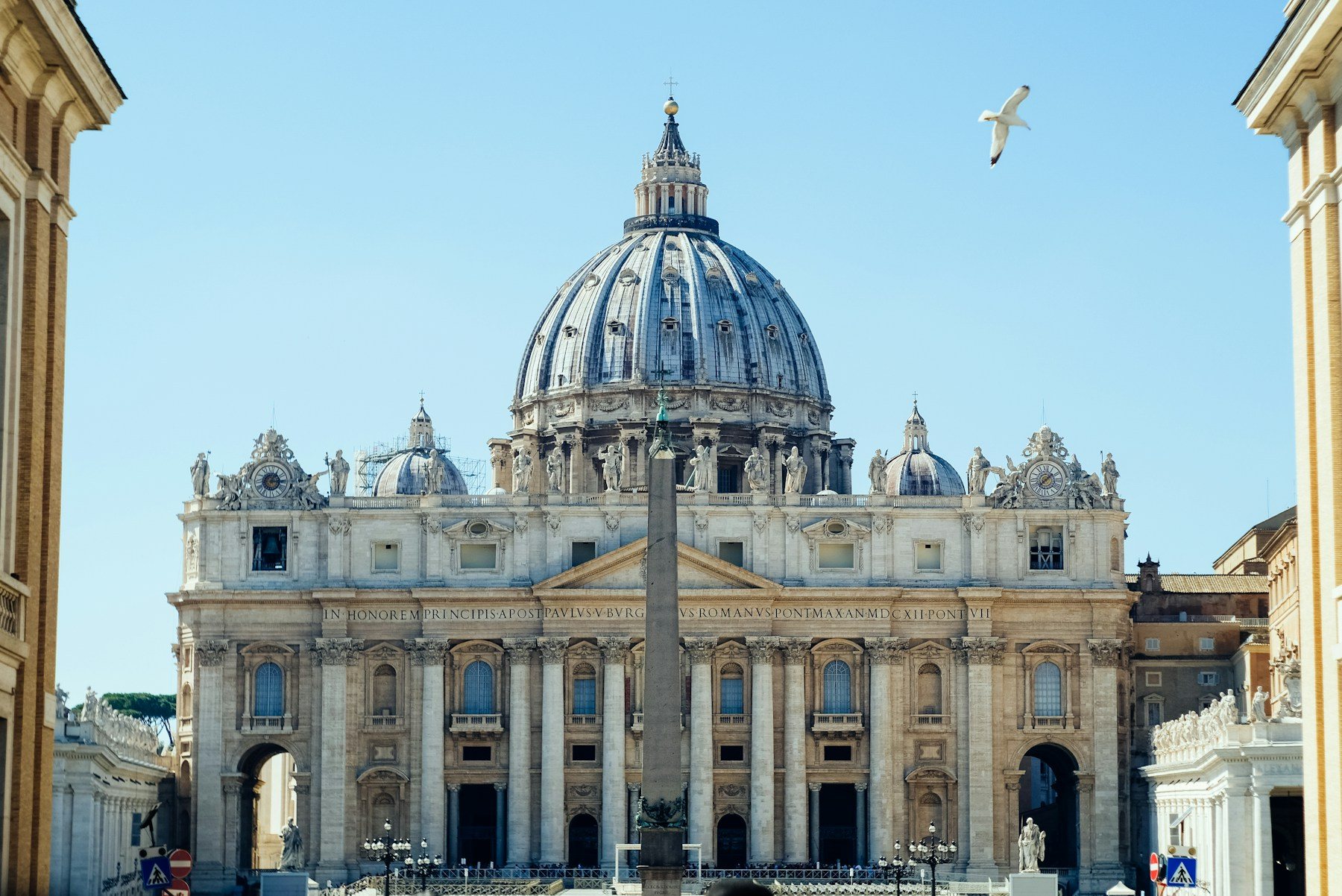
A practical guide to visiting the smallest country in the world: how to reach it from Rome, what you can enter for free, how to plan St. Peter’s Basilica and the Vatican Museums, and what to know before you go.
Vatican City is the smallest sovereign state in the world, with an area of about 0.49 square kilometers (44 hectares) and about 882 residents in 2024. It is an enclave inside Rome, and for visitors it works like a neighborhood: there are no passport controls when you enter from surrounding Italian territory, and the main sights are within a few minutes of each other on foot.
What makes it worth a trip is the density. St. Peter’s Basilica, the Vatican Museums and the Sistine Chapel together draw millions of people a year. The museums alone received 6,825,436 visitors in 2024, and St. Peter’s Basilica and the Apostolic Palace counted about 11 million visitors in 2023. That is why the most useful advice is about timing and booking, not about what to see.
Our short video on Vatican City is below, and this page covers the planning behind it. For the quick version, see our Vatican City travel guide.
Vatican City became independent through the Lateran Treaty, signed on 11 February 1929 between the Holy See and the Kingdom of Italy. It took effect on 7 June 1929. The treaty ended the dispute that followed the loss of the Papal States in 1870, after which the popes had lived within the Vatican.
Understanding the setup helps with planning. Vatican City is the state, and the Holy See is the sovereign entity that governs it. For most visitors this only matters for two things. First, the state has its own rules, security checks and post office. Second, Italian police patrol St. Peter’s Square up to the steps of the basilica, so you can stand in the square without feeling that you have crossed a border.
Citizenship is not by birth. It is granted by office, meaning an appointment to a service role for the Holy See, and it usually ends when the appointment ends. Cardinals, diplomats and others who live in the city because of their work can be citizens, and so can spouses and children who live with them. About 372 Vatican citizens live elsewhere, mostly diplomats and cardinals based in Rome. Anyone who loses Vatican citizenship without another nationality becomes an Italian citizen.
Vatican City is a landlocked enclave within Rome, so you reach it through the city. Rome’s metro Line A runs northwest past the Vatican, and the stop for the museums is Ottaviano – San Pietro – Musei Vaticani. The museums’ official address is Viale Vaticano 6. Trams and buses also stop near the Vatican, and Rome’s main railway station, Termini, is the hub for most buses.
From the airports, Rome has two main options. Fiumicino (Leonardo da Vinci) is linked to the city by the Leonardo Express and other trains and by buses. Ciampino is closer to the center, but it has no direct train connection. Public transport tickets must be bought before boarding and validated when you enter the metro or board a bus. Taxis are white and run on meters within the city walls, and they are the most expensive option.
The Vatican Museums entrance and St. Peter’s Square are on different sides of the walls, and the walk between them takes a while, so plan them as two separate visits or leave a gap between them.
Entry to St. Peter’s Square and St. Peter’s Basilica is free, according to Wikipedia. Tickets are needed for general papal audiences and major ceremonies. The Vatican Museums, which include the Sistine Chapel, usually charge an entrance fee. The gardens are not open to the general public, although small guided tours can be arranged. Other parts of Vatican City are open only to people with business there.
We do not list prices or opening hours here, because they change. The official Vatican Museums website is the place to check them, and it also lists any closures for religious holidays.
St. Peter’s Basilica was built between 1506 and 1626. The groundbreaking was on 18 April 1506, and Pope Urban VIII dedicated the basilica on 18 November 1626. Wikipedia’s article also mentions 1615 as the year the current basilica was finished, so sources differ on the date. The designers included Bramante, Michelangelo, Giacomo della Porta, Carlo Maderno and Gian Lorenzo Bernini.
The dome is Michelangelo’s. He redesigned it in 1547, and Giacomo della Porta and Domenico Fontana completed it in 1590. Its internal diameter is 41.47 meters. Under the dome stands the bronze baldachin by Bernini, 28.74 meters tall and his first work at St. Peter’s.
Look for Michelangelo’s Pietà, dated 1498 to 1499, in the first chapel of the north aisle. The northernmost bronze door of the facade is the Holy Door. It is opened only for jubilees and is bricked up between holy years. The present door was designed by Vico Consorti in 1950.
Below the basilica, the Vatican Grottoes hold more than 100 tombs, including 91 popes. The most recent burial was Pope Benedict XVI on 5 January 2023. Excavations that began in 1939 beneath the crypt uncovered shrines from different periods and a fourth-century vaulted tomb known as the Tomb of the Julii.
Pope Julius II founded the Vatican Museums in the early 16th century, and the official founding year is given as 1506. The collection has about 70,000 works, of which about 20,000 are on display, spread across 24 galleries or rooms. The Sistine Chapel is the last room on the visitor route, which means most people walk through the whole museum to reach it.
The Sistine Chapel is decorated with frescoes by Perugino, Domenico Ghirlandaio and Sandro Botticelli. Michelangelo painted the ceiling and the Last Judgment on the altar wall. With millions of visitors, the chapel is crowded in all seasons, so the most useful step is to book a timed entry in advance on the official site.
The following is our own suggestion, built from the facts above, not an official itinerary.
Rome itself receives 7 to 10 million tourists a year, and more in holy years. According to Wikipedia’s counts for 2023, St. Peter’s Basilica and the Apostolic Palace attracted about 11 million visitors and the Vatican Museums about 6.76 million, so these are two of the busiest attractions in the city. Choose the less crowded times of day wherever you can.
Vatican City is not a place to stay overnight as a tourist. Rome is the base. The area around the Vatican, including the Prati district, is walkable to the museums and the basilica, while the area near Termini station is better for rail and airport connections.
Rome charges a tourist tax of €3 to €7 per person per night depending on the accommodation type. Children under 10 are exempt, and the tax stops applying after 10 days. The euro is used in Vatican City under a special agreement with the EU, and Vatican City does not issue its own banknotes.
The Vatican has its own post office, and mail is a popular souvenir, but check the current rules before you plan to send anything.
Most problems at the Vatican are about timing, not about money. Allow time for the security check at St. Peter’s, because the line can be long at midday. Dress rules for churches generally ask visitors to cover shoulders and knees, so check the official Vatican pages before you go. Italian is the everyday language, and Latin is used for the Holy See’s official documents, so signs and cash machines may include it.
Yes. It is the smallest sovereign state in the world, with an area of about 0.49 square kilometers. It became independent through the Lateran Treaty of 1929.
There are no passport controls for visitors who enter from Italian territory. You still pass security checks at St. Peter’s Basilica and the Vatican Museums, and you should carry ID.
Yes, entry to St. Peter’s Square and Basilica is free. Tickets are needed for papal general audiences and major ceremonies.
The Vatican Museums received 6,825,436 visitors in 2024, and Wikipedia counts about 11 million visitors to St. Peter’s Basilica and the Apostolic Palace in 2023.
We suggest at least half a day for the Vatican Museums and about two hours for St. Peter’s Basilica and Square. Book the museums for a specific time.
About 882 people lived there in 2024, the only country with fewer than 1,000 residents.
Citizenship is granted by office, meaning an appointment to a service role for the Holy See, and usually ends when the appointment ends. It is not granted by birth.
Rome. Vatican City does not have tourist hotels, and the Prati area is within walking distance of the museums and the basilica.
Rome is the base for a Vatican visit, because Vatican City itself has no hotels for tourists. Compare prices and reviews, and check the cancellation terms before you reserve.
See stays in Rome on Booking.com →
Some links on this page are affiliate links. If you book through them, Letsa Atlas may earn a small commission at no extra cost to you.
We checked this guide on November 10, 2026. Opening hours, ticket prices, dress rules and security procedures change, and the Vatican closes for some religious events, so always confirm them on the official Vatican pages. Confirm details with official sources before you go.
Sources checked November 10, 2026: Wikipedia: Vatican City · Wikipedia: Vatican Museums · Wikipedia: St. Peter’s Basilica · Wikipedia: Tourism in Rome · Vatican Museums official site