A practical guide to the cotton castle of Türkiye: how the terraces form, tickets and gates, the barefoot walk, Cleopatra’s Pool, Hierapolis and its theater, balloon flights, getting there and a 2-day plan.
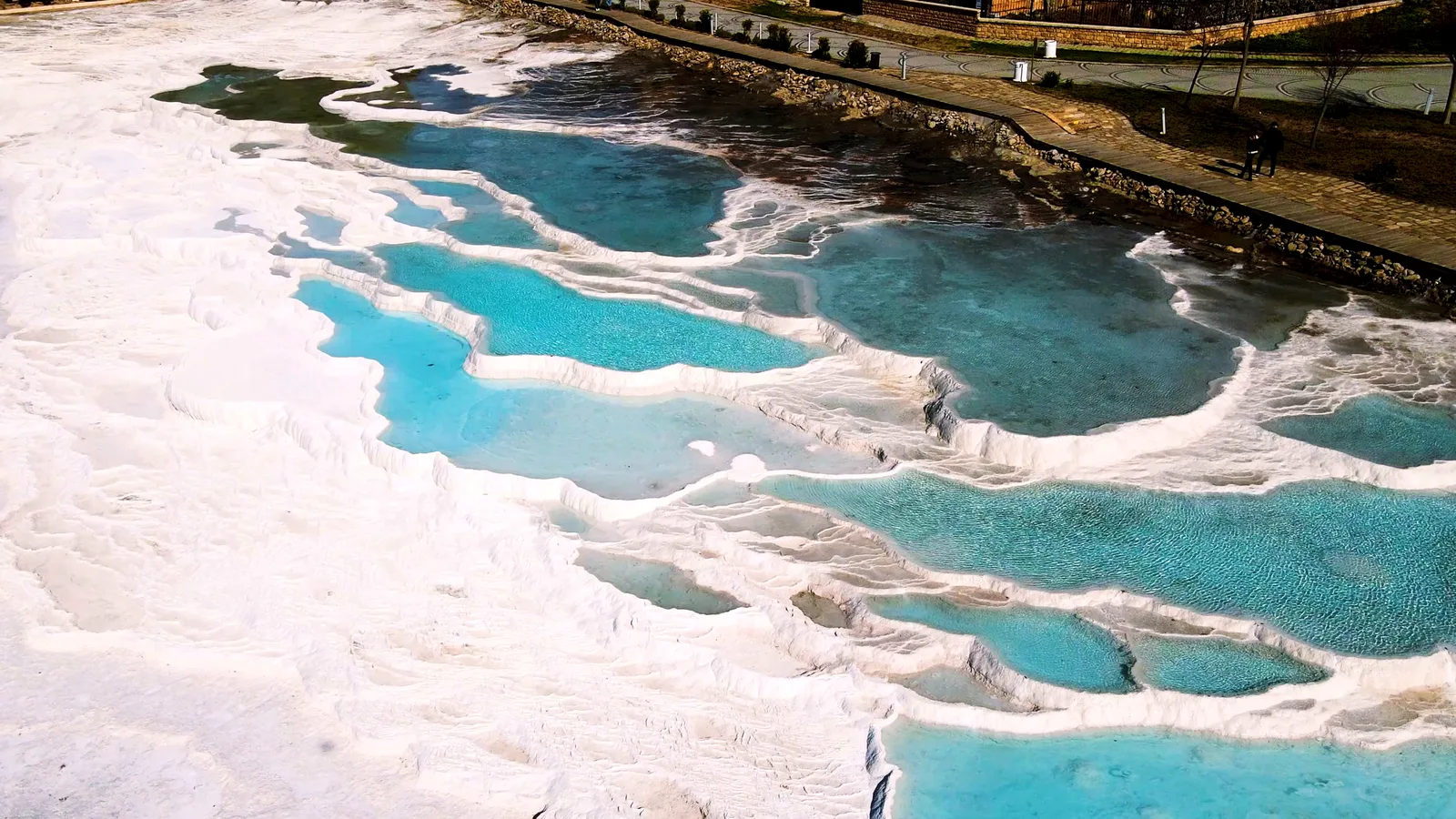
Pamukkale, “cotton castle” in Turkish, is a hillside of white travertine terraces in Denizli Province in southwestern Türkiye, in the valley of the Büyük Menderes River. Wikipedia gives the formation as about 2,700 meters long, 600 meters wide and 160 meters high. From a distance it looks like snow or a glacier, but it is stone left by warm spring water.
A visit combines two things on one ticket: the terraces, where you walk barefoot through warm, shallow pools, and Hierapolis, the ancient spa city on the plateau above, with its Roman theater, baths and huge necropolis. You can also swim in Cleopatra’s Pool among sunken column pieces and fly over the whole site at sunrise by balloon.
Our short Pamukkale video is below. For the quick version, see our Pamukkale travel guide.
Wikipedia says there are 17 hot springs in the area, with temperatures ranging from about 35 to 100 degrees Celsius. The water that feeds the terraces is carried about 320 meters to the head of the formation and is supersaturated with calcium carbonate. When it reaches the surface, carbon dioxide escapes from it and calcium carbonate is deposited, first as a soft gel that eventually crystallizes into travertine.
Wikivoyage explains the chemistry simply: water charged with carbon dioxide dissolves limestone underground, then blows off its gas when it emerges, and the dissolved stone is laid down again. Over thousands of years the water cascading down the hillside has built terraces with a raised lip on each edge, so every step holds a shallow pool. Travertine takes its name from Tivoli near Rome, where the stone was quarried for building.
People have been drawn here since ancient times by the scenery, the hot water and the vapours from below. Wikivoyage says the earliest known settlement dates from the 7th century BC and that the town was known as Hierapolis by the 2nd century BC. Wikipedia describes Hierapolis as a healing centre where doctors used the thermal springs to treat their patients. Repeated earthquakes eventually emptied the city.
Mass tourism nearly ruined the terraces. Wikivoyage describes how hotels were built on the plateau from about 1980 and visitors walked all over the stone. After Hierapolis-Pamukkale became a UNESCO World Heritage Site in 1988, most terraces were closed and the hotels on the plateau were removed. Today the authorities regulate the water flow and rest some sections so the white surface can recover.
The terraces and Hierapolis are within the same ticketed area. Wikivoyage says there are three gates and you can enter, buy tickets or exit at any of them. It listed an entry price of 30 euros in 2026 with a compulsory audio guide on top, charged in Turkish lira if you pay by card, and opening hours of 08:00 to 20:30, with the South Gate opening earlier in summer. Check the current price before you go, because it changes often.
The classic way to see Pamukkale is to walk up the cascade from the Town Gate to the museum on the plateau. Wikivoyage says it takes about 15 minutes, that shoes are not allowed on the travertine and that you carry them in your hand. The warm water runs over your feet in shallow turquoise pools, while the white stone glows in the sun.
This path is the only part of the terraces that visitors may walk on. Most of the rest is closed to protect it, and Wikivoyage warns that in winter and in dry spells many pools can be empty, because hotel spas tap the spring water. The wet stone can be slippery and rough in places, so take your time, especially going downhill.
On the plateau, Cleopatra’s Pool, also called the Antique Pool, is a natural hot swimming pool where pieces of ancient marble columns lie under the water. Wikipedia says tourists can bathe there among the submerged columns, and Wikivoyage notes that it has its own fee, a shop selling swimsuits and towels, and lockers. Despite the name, the link to Cleopatra is a legend.
Hierapolis spreads across the plateau above the terraces. Its highlight is the Roman theater, which Wikivoyage describes as a well-restored theater with 12,000 seats, looking out over the valley. Other sights include the gymnasium near the South Gate, the Temple of Apollo, the Ploutonion, a shrine where poisonous gases rise from below, and a necropolis that stretches for about 2 kilometers towards the North Gate.
The archaeology museum, inside the old Roman baths, displays finds from the excavations, including carved sarcophagi. Allow at least half a day for the terraces and Hierapolis together, and bring water, because there is little shade on the plateau.
For the view from above, Wikivoyage lists local companies that fly over the area by hot air balloon, tandem paraglider or gyrocopter, with pick-up from hotels in the village. Balloon flights usually take off around sunrise, when the white terraces turn pink and gold. Flights depend on the weather, so keep a spare morning if this is a priority, and choose an operator with good reviews.
Wikivoyage calls late spring and early summer the best time to visit. Pamukkale has a hot inland Mediterranean climate: summers can be fiercely hot with no shade and a dazzling white light from the terraces, the pools may be dry in late summer, and in winter walking the cold cascades barefoot is unpleasant. Early morning and sunset are the most beautiful and least crowded times of day.
For public transport, travel via Denizli, which Wikivoyage says has frequent buses from Istanbul, Ankara, Izmir and other cities. Local buses to Pamukkale leave from the lower level of Denizli bus station about every 20 minutes and take about 20 minutes. Drivers do not need to go into Denizli, because Pamukkale is about ten minutes from a motorway junction.
Many visitors come on day tours from coastal resorts. Wikivoyage notes that tour buses run from all the resorts within about 100 kilometers, and longer day trips are offered from places such as Antalya, Izmir and Kuşadası. Staying a night in the village lets you see the terraces at their quietest.
Pamukkale village sits right below the terraces and has many simple guesthouses and hotels, several with pools fed by the warm water. Wikivoyage notes that the hotels on the plateau were removed after the UNESCO listing, so accommodation is in the valley. Nearby Karahayıt has larger spa hotels around its own red-coloured springs, and Denizli has a wider choice. One or two nights are enough for most visitors.
Entry rules depend on your passport, so check the official Turkish requirements for your nationality, including visa rules and passport validity, before you travel. The currency is the Turkish lira, and Wikivoyage notes that the site ticket is priced in euros but charged in lira by card, so check the conversion before you pay.
This is our own suggestion, not an official itinerary.
No. The white terraces are travertine, a stone left by warm mineral water. When the spring water reaches the surface, carbon dioxide escapes and calcium carbonate settles as a soft gel that hardens into white stone.
Wikipedia says there are 17 hot springs in the area with temperatures from about 35 to 100 degrees Celsius. The water in the shallow pools you walk through is warm, not hot.
You can wade through the open pools on the terraces, and you can swim in Cleopatra’s Pool, a natural hot pool on the plateau with ancient column pieces lying in the water. It has its own entrance fee.
Yes. Wikivoyage says shoes are not allowed on the travertine, so you walk the open cascade barefoot and carry your shoes.
No. Most of the terraces are closed to protect them. Visitors use the cascade path between the Town Gate and the museum on the plateau.
The terraces and Hierapolis share one ticket, and the price changes often. Wikivoyage listed 30 euros in 2026, plus a compulsory audio guide, payable in lira by card. Cleopatra’s Pool costs extra. Check the current price before you go.
Wikivoyage recommends late spring and early summer. Summers can be very hot with no shade, the pools may be dry in late summer, and winter is cold for walking barefoot.
Travel to Denizli, which has frequent intercity buses from Istanbul, Ankara, Izmir and elsewhere, then take a local bus to Pamukkale, which Wikivoyage says runs about every 20 minutes and takes about 20 minutes. Many visitors come on day tours from coastal resorts.
Yes. Wikivoyage lists hot air balloon, tandem paraglider and gyrocopter flights over the area, with pick-up from local hotels.
Hierapolis is the ancient city on the plateau above the terraces. It became a healing centre where doctors used the hot springs, and today its Roman theater, necropolis and baths can be visited with the same ticket.
Compare Pamukkale and Hierapolis day trips, hot air balloon and paraglider flights, and tours from Antalya, Izmir, Kuşadası and other coastal resorts, with reviews and free-cancellation options.
Find Pamukkale tours on Viator →Compare on GetYourGuide →
Travel insurance. Medical care abroad can be expensive, and slippery terraces, summer heat and activities such as balloon or paraglider flights add risk on a trip like this, so many travellers buy cover before they leave. One option is SafetyWing Nomad Insurance. Read the policy wording to see what it covers, including organised activities, before you buy.
Pamukkale village below the terraces is the easiest base, with guesthouses and hotels, many with thermal pools. One or two nights let you see the terraces at sunrise and sunset. Compare prices and reviews, and check the cancellation terms before you reserve.
See stays in Pamukkale on Booking.com →Compare on Expedia →
Some links on this page are affiliate links. If you book through them, Letsa Atlas may earn a small commission at no extra cost to you.
We checked this guide on November 18, 2026. Prices, fees, hours, timetables and entry rules change. Confirm them with the site, tour operators, bus companies, the Turkish authorities and your own government before you travel.
Sources checked November 18, 2026: Wikipedia: Pamukkale · Wikivoyage: Pamukkale · Wikipedia: Hierapolis · UNESCO: Hierapolis-Pamukkale