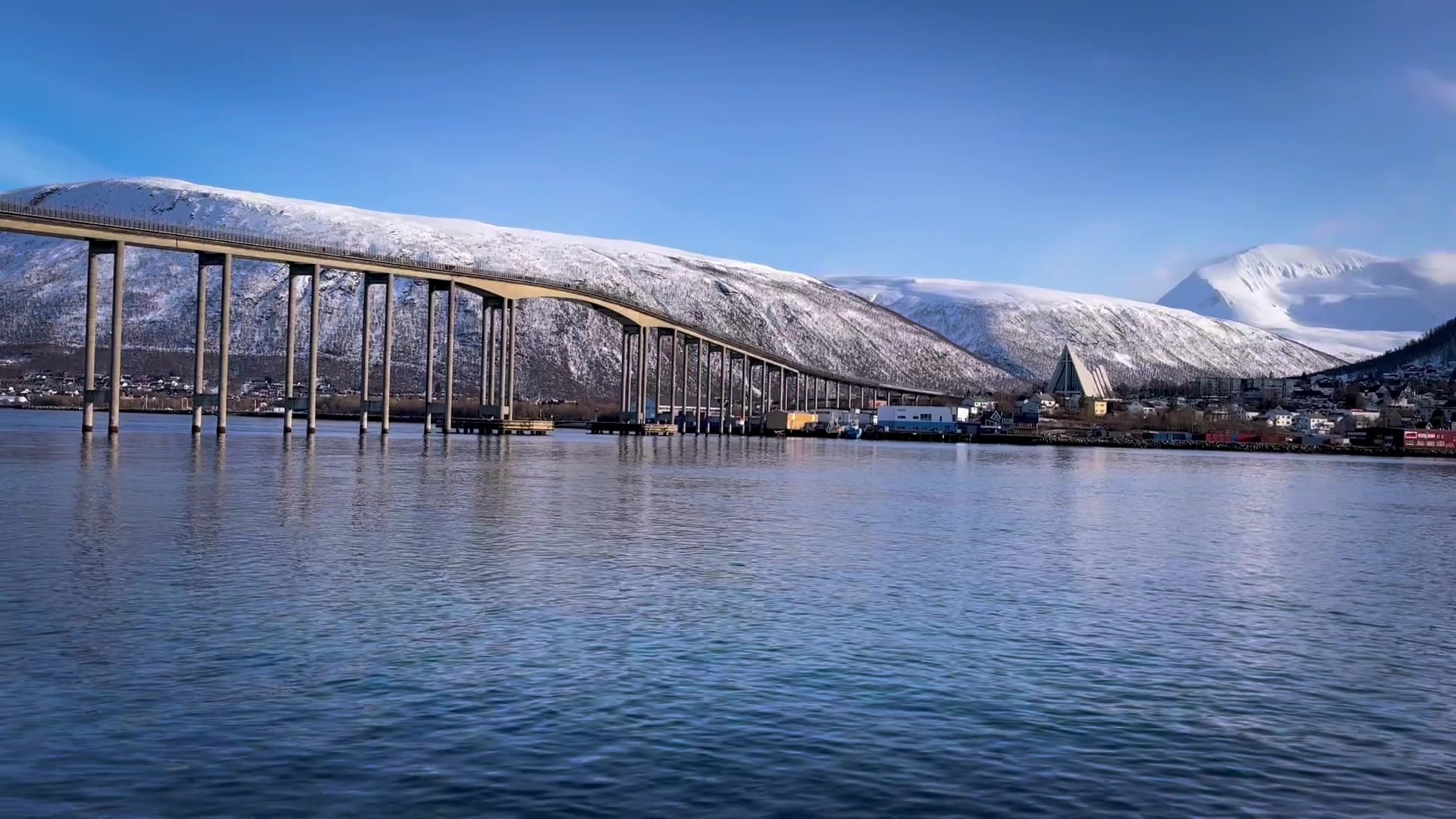
A practical guide to Tromsø between September and April: when the aurora season runs, how the light and weather change month by month, what to put on, what to do besides chasing the lights, and how to get around.
Tromsø is a city of about 80,000 people on the island of Tromsøya, more than 300 kilometers north of the Arctic Circle. It sits directly under the aurora oval, the ring around the pole where northern lights appear most often, which is why it is one of the best-known places to look for them.
The aurora season runs from late August to early April, and organised northern lights tours run from September to early April. Autumn and spring are the most active periods. Winter, from December to February, is the busiest and most atmospheric time to visit, but also the darkest and coldest. If you want long nights, snow, whales and dog sledding in one trip, plan for late November to February. If you want easier days and fewer crowds, March and early April are a calmer option.
The Short that started this guide is below. It covers the highlights in 18 seconds, and the rest of this page is the detail you need to plan the trip. For a shorter overview, see our Tromsø travel guide.
Visit Tromsø, the official tourism site, gives the season as late August to early April, whenever the sky is dark enough. In summer the sky never gets dark, and the aurora is not visible from late April to mid August. Guided tours run from September to early April. Visit Norway says autumn and spring are the most active seasons, when solar activity most often interacts with Earth's magnetic field.
The lights can appear at any time of the night, so a long evening outdoors gives you more chances than a short one. They can be anything from a faint pale arc to moving green and purple curtains, and you will not know until you are outside under a clear sky.
You need three things: darkness, activity in the sky and, above all, clear weather. Tromsø is on the coast, and coastal cloud often hides the aurora even when it is there. That is the main reason guided hunts exist. The guides watch the weather and drive to wherever the sky is clearest, sometimes far outside the city, instead of waiting where you are.
Yes. On clear nights the aurora may be visible from the city itself, including darker spots such as Prestvannet. Away from street lights is better. If you go alone, check the weather and cloud forecast each evening, dress for standing still in the cold, and be ready to go out late.
Visit Tromsø describes two broad types. Some tours focus on travelling to find clear skies. Others combine the viewing with a fixed location or base camp and an activity. When you compare operators, check what is included before you pay: warm clothing, food, photography, hotel pickup and toilet access. No tour can guarantee the aurora, so it is worth booking more than one night. Popular and small tours can sell out in the busy winter months, so book before you arrive.
The table below combines the official aurora information with Tromsø's 1991 to 2020 climate averages. Temperatures are daily averages in degrees Celsius, so the real day can be warmer or colder.
| Month | Light | Typical temperature | Good for |
|---|---|---|---|
| September | Evenings getting shorter, colorful mountains | Crisp, cool days | Aurora starts to strengthen, especially in the second half |
| October | Short days, low golden midday light | Mean 3.1, high about 5.2 | Prime aurora time, cafes, museums |
| November | Sun visible early in the month, gone from about 28 November | Mean 0.2, high about 2.1 | Whales, Christmas lights, fewer crowds than December |
| December | No sun, midday glow in red, pink and gold | Mean -1.7, high about 0.3 | Festive city, aurora, whales, dog sledding |
| January | Polar night until about 14 January, then the light returns | Mean -3.0, high about -1.0 | Long nights, whales until the end of the month |
| February | Daylight grows quickly, evenings still dark | Mean -3.3, high about -1.2 | Aurora, dog sledding, Sami National Day on 6 February |
| March | Strong daylight, nights still dark | Mean -1.9, high about 0.6 | Aurora plus daytime skiing, fewer crowds |
| April | Long days, light feels generous | Mild in the sun, cold evenings | Skiing and easier days; the aurora season ends in early April |
Visit Norway lists December, January and February as the peak season, when attractions and hotels fill up quickly. September and October offer autumn colors and a chance at the aurora before the coldest weather. March and early April bring fewer crowds and easier access to activities.
Snow is common but not guaranteed early in the season. An average winter has about 160 days with at least 25 centimeters of snow on the ground, and the deepest snow ever measured was 240 centimeters in April 1997.
Tromsø's polar night runs from about 28 November to 14 January, roughly 48 days, when the sun stays below the horizon. Mountains hide it for even longer: the sun does not reach the city between about 21 November and 21 January.
It is not as dark as it sounds. Around midday in December the horizon glows in red, orange, pink and gold, like a long dawn that never quite becomes morning. In early afternoon the light turns deep blue and then fades. Add snow, street lights and a clear sky and the city looks bright for much of the day. Many visitors say that walking over the bridge at noon in this light is as memorable as the aurora itself.
The opposite happens in summer. The midnight sun lasts from about 19 May to 27 July, and the sun does not set at all. That is a different trip, with hiking, kayaking and fishing instead of the lights.
Visit Tromsø advises dressing in layers and keeping every part of the body protected, because the Arctic weather can change quickly. This is a simple system.
Bring a tripod if you want to photograph the aurora, and keep a spare phone battery warm inside your jacket, since cold drains batteries quickly.
From November to January, orcas, humpback whales and minke whales swim into the fjords to hunt herring. November through the end of January is usually the peak, but sightings depend on the weather and the herring. The Short shows orcas feeding in these waters.
Huskies pull guided sleds through the winter landscape. Reindeer sledding is often combined with a traditional meal and an introduction to Sami culture in a lavvo, a traditional Sami tent. Sami National Day is on 6 February, and the week around it is celebrated as Sami Week, including a reindeer race on the main street, Storgata.
The Fjellheisen cable car rises about 420 meters to Storsteinen, with views over the city and, on a clear night, a place to look for the aurora. Guided snowshoeing tours are available at the top.
The compact center is easy to explore on foot. The Tromsø Bridge leads from the island to the mainland suburb of Tromsdalen, where the Arctic Cathedral stands. It was built in 1965 and is a parish church rather than a cathedral. From the cathedral it is about 15 minutes more on foot to the lower cable car station. The city also has the University of Tromsø, opened in 1972 and described as the northernmost university in the world, and a northern lights observatory founded in 1927. Cafes, museums and the cinema are good bad-weather options in October and November.
Tromsø Airport, also called Langnes, opened in 1964 and sits on the main island, close to the center. The official tourism site lists three ways into town:
Once you are in town, city buses run daily and the center is a good size for walking. Express boats serve nearby Finnsnes, Harstad, Lysnes and Skjervøy all year round, with tickets sold in the Svipper and Entur apps.
Driving in northern Norway in winter is demanding. Roads can be narrow, winding, icy and slippery, and cars should be prepared for the cold season, from October to April. If you do not have winter driving experience, use public transport or a guided tour instead.
Our suggestion, based on the season facts above rather than an official rule: plan four to five nights. The reason is simple. The aurora needs clear weather, and weather changes fast, so more nights means more chances. A sample plan:
Book the tours you care about before you arrive, since December to February fills up. Keep the last evening flexible, in case clouds moved your best night.
Tromsø's official tourism site says the aurora season runs from late August to early April, when the sky is dark enough, and organised tours run from September to early April. Visit Norway adds that autumn and spring are the most active seasons. Within that window, October is described as prime time, and January to March also have long, dark nights.
Yes, on clear nights. Visit Tromsø says the aurora may be visible from the city, including darker spots such as Prestvannet. Cloud is the main problem, and guided tours drive out of the city to find clearer skies when the weather is poor.
No. Sightings depend on auroral activity, cloud cover and local weather. Booking more than one night or tour gives you more chances, and it is worth reading each operator's own conditions before you pay.
Less cold than the latitude suggests. The 1991 to 2020 averages show a daily mean of about -1.7 °C in December, -3.0 °C in January, -3.3 °C in February and -1.9 °C in March. Wind, damp air and long evenings outside feel much colder than the numbers, so dress in layers.
There is no direct sun, but the sky is not black at midday. In December the horizon glows red, orange, pink and gold around noon, and the early afternoon turns deep blue before dark. The polar night runs from about 28 November to 14 January.
Orcas, humpback whales and minke whales come into the fjords to hunt herring from November to January. November through the end of January is usually the peak, but sightings depend on the weather and where the herring are.
No. The city centre is compact and walkable, city buses run daily, and most winter activities pick you up. Winter roads in northern Norway can be icy, narrow and winding, so if you are not used to winter driving, public transport or a guided tour is the safer choice.
There is no number that guarantees the aurora, but several nights give you several chances at clear weather. We suggest at least four nights if the lights are your main goal.
Tromsø is the easiest base for this trip, since tours pick up from the center. Compare prices and reviews, and check the cancellation terms before you reserve.
See stays in Tromsø on Booking.com →
Some links on this page are affiliate links. If you book through them, Letsa Atlas may earn a small commission at no extra cost to you.
We checked this guide on November 8, 2026. Tour schedules, prices and sightings change with the weather and season, and the northern lights and whales are never guaranteed. Confirm details with official sources before you reserve.
Sources checked November 8, 2026: Visit Tromsø: Northern lights FAQ · Visit Tromsø: Getting around · Visit Norway: Tromsø in winter · Wikipedia: Tromsø · Arctic Norway: Arctic light through the year