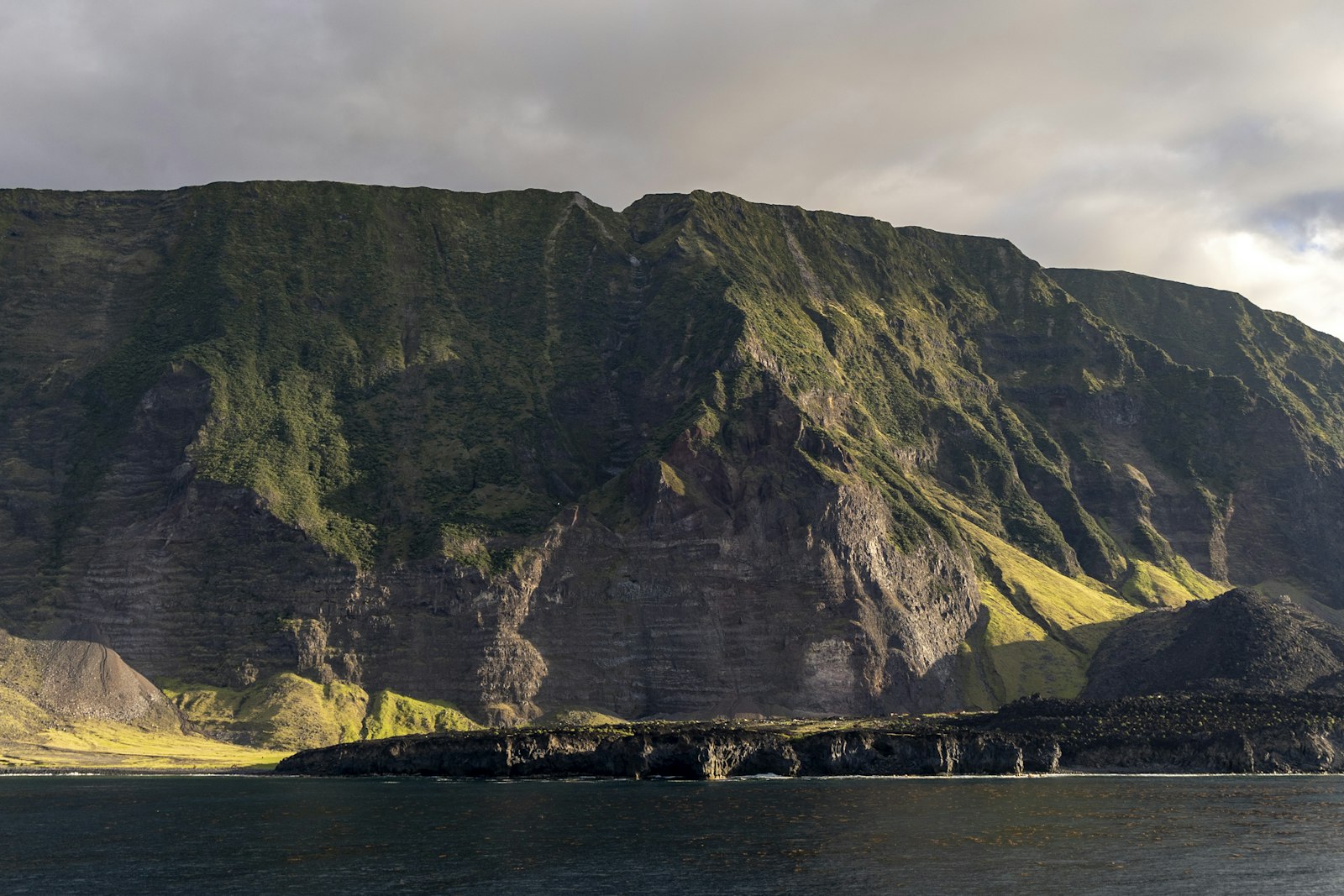
A practical guide to Tristan da Cunha: why there is no airstrip, how ships from Cape Town work, how to ask permission, insurance, money, where to stay and what you can do on the island.
Tristan da Cunha is a group of volcanic islands in the South Atlantic Ocean. Only the main island is inhabited, and it has one settlement, Edinburgh of the Seven Seas, locally called “The Settlement”. Wikipedia gives populations of 243 at the June 2021 census and 221 in its infobox for 2026, so the community is under 250 people. The territory covers 207 square kilometres, and the main island 98.
The island has no airstrip, so all visitors arrive by ship. The voyage from Cape Town takes about six days according to Wikipedia, or five to ten days depending on weather and ship according to Wikivoyage. Visits must be planned months in advance and approved by the Island Council, and visitors need a confirmed, fully paid return ticket and health insurance covering medical evacuation.
Our 18-second Short about Tristan da Cunha is below. For the quick version, see our Tristan da Cunha travel guide.
Tristan da Cunha is one of three constituent parts of the British Overseas Territory of Saint Helena, Ascension and Tristan da Cunha, and it has its own constitution. Wikipedia places it 2,170 kilometres from Saint Helena. The group includes the main island, the Gough Island and Inaccessible Island wildlife reserves, and the uninhabited Nightingale Islands.
The currency is the pound sterling. The economy relies on the Tristan rock lobster fishery, stamp and coin sales, and limited tourism. In 1961, an eruption of a parasitic cone of Queen Mary’s Peak forced the evacuation of all 264 residents, a reminder that the island is a volcano.
Wikipedia names three vessels that serve the island from Cape Town: MV Lance, MFV Edinburgh and SA Agulhas II, usually fewer than a dozen visits a year. Wikivoyage adds that visitors have the lowest priority for passage, so you should plan departures when other ships leave soon after, and that cruises visit in March and April. Yachts need clearance from the police or the harbourmaster.
That means a trip is built around the ship schedule, not your preferred dates. Weather decides when ships can land passengers, so delays are normal. Build slack into your plans before and after.
Wikipedia says visits must be approved by the Island Council and planned months in advance. Wikivoyage suggests applying more than a year ahead, by email to the Tristan government, with dates, preferred vessel, accommodation type, nationality, age and purpose of visit. A police certificate may be requested. Journalists must say so, and filmmakers need a permit. No visas are required and there are no nationality-based restrictions.
Visitors also need a confirmed, fully paid return ticket and health insurance covering medical evacuation. Confirm the current process with the official government channels.
The currency is the pound sterling. Wikivoyage says credit cards are not accepted, and cash and some foreign currencies can be exchanged at the treasury. There is no mobile network. A shared satellite internet cafe exists, and post can take about two weeks. Plan to be offline for much of the trip and tell family in advance.
Options are self-catering lodging or a home stay with meals. Wikivoyage warns that opening hours of the shop, post office cafe and the Albatross Bar are unreliable, and places are most likely open when a ship is in port. Bring snacks and medication with you, because supplies are limited.
Tap water comes from a filtered spring and is safe to drink, according to Wikivoyage.
Walking is the main way to get around, on steep and rugged ground outside the village. A morning bus runs to the Potato Patches, about three miles away. Volcano climbs need a guide and depend on the weather, and costs are shared between hikers.
Wildlife viewing is a major attraction, since Gough Island and Inaccessible Island are wildlife reserves. Access to those reserves is separately controlled, so ask the island authorities.
Visitors become part of a very small community for the length of their stay. Expect people to know who you are, expect to be invited into homes, and expect to follow local rules. The community decides who can come, which is why the permission process exists.
Be respectful and flexible. If the ship is delayed or the weather turns, you may have to stay longer. That is part of the experience, and it is the reason insurance and a fully paid return ticket are required.
Tristão da Cunha first sighted the islands in 1506 but rough seas prevented a landing. The first undisputed landing was on 7 February 1643 by a Dutch East India Company crew. Jonathan Lambert arrived in December 1810 as the first permanent settler, the United Kingdom annexed the islands on 14 August 1816, and William Glass stayed after the garrison left in November 1817, forming the nucleus of the permanent population.
The main island is dominated by Queen Mary’s Peak, 2,062 metres high and classed as active, with its last eruption in 1961. After that eruption, all 264 residents were taken to Cape Town and later to the United Kingdom, settling near Calshot in Hampshire. Most families returned in 1963.
The male founders shared seven surnames: Glass, Green, Hagan, Lavarello, Repetto, Rogers and Swain. Collins, Squibb and Patterson came with women returning from the early 1960s evacuation. If you meet people on the island, you will hear these names often.
The climate is cool and wet. Wikipedia gives a mean annual daily maximum of 17.3 °C and a minimum of 12.4 °C, with a record high of 24.4 °C and a record low of 4.6 °C. Average annual rainfall is 1,681 millimetres over 252 rainy days, so pack waterproofs and expect a fair amount of wind and cloud.
The islands are home to 13 known breeding seabird species, including northern rockhopper penguins, Atlantic yellow-nosed albatrosses and sooty albatrosses. The Tristan albatross breeds only on Gough and Inaccessible Islands. Bird lovers often plan their trip around those colonies, though access to the reserves is controlled.
The island has its own services despite its size. St. Mary’s School serves ages 4 to 16, and its current building opened in 1975. The Camogli Healthcare Centre opened officially on 7 June 2017 and enabled local births on the island. Tristan da Cunha English is described by Wikipedia as the smallest and most isolated native-speaker community of English.
The reason visitors need insurance for medical evacuation is the distance from any major hospital. Treat the healthcare centre as a basic local facility, not a substitute for emergency care.
This is our own suggestion, not official guidance.
Only by ship. There is no airstrip. Vessels such as MV Lance, MFV Edinburgh and SA Agulhas II serve the island from Cape Town.
About six days from Cape Town according to Wikipedia, and five to ten days depending on weather and ship according to Wikivoyage.
Yes. Visits must be approved by the Island Council and planned months in advance. Wikivoyage suggests applying more than a year ahead.
Wikipedia gives 243 at the June 2021 census and 221 in its infobox for 2026.
The pound sterling. Credit cards are not accepted, according to Wikivoyage.
There is no mobile network. A shared satellite internet cafe exists.
A parasitic cone of Queen Mary’s Peak erupted and all 264 residents were evacuated.
Self-catering lodging or a home stay with meals.
We checked this guide on November 8, 2026. Permission rules, ship schedules, fees and insurance requirements change. Confirm the current process with the Tristan da Cunha government before you plan anything. Confirm details with official sources before you go.
Sources checked November 8, 2026: Wikipedia: Tristan da Cunha · Wikivoyage: Tristan da Cunha