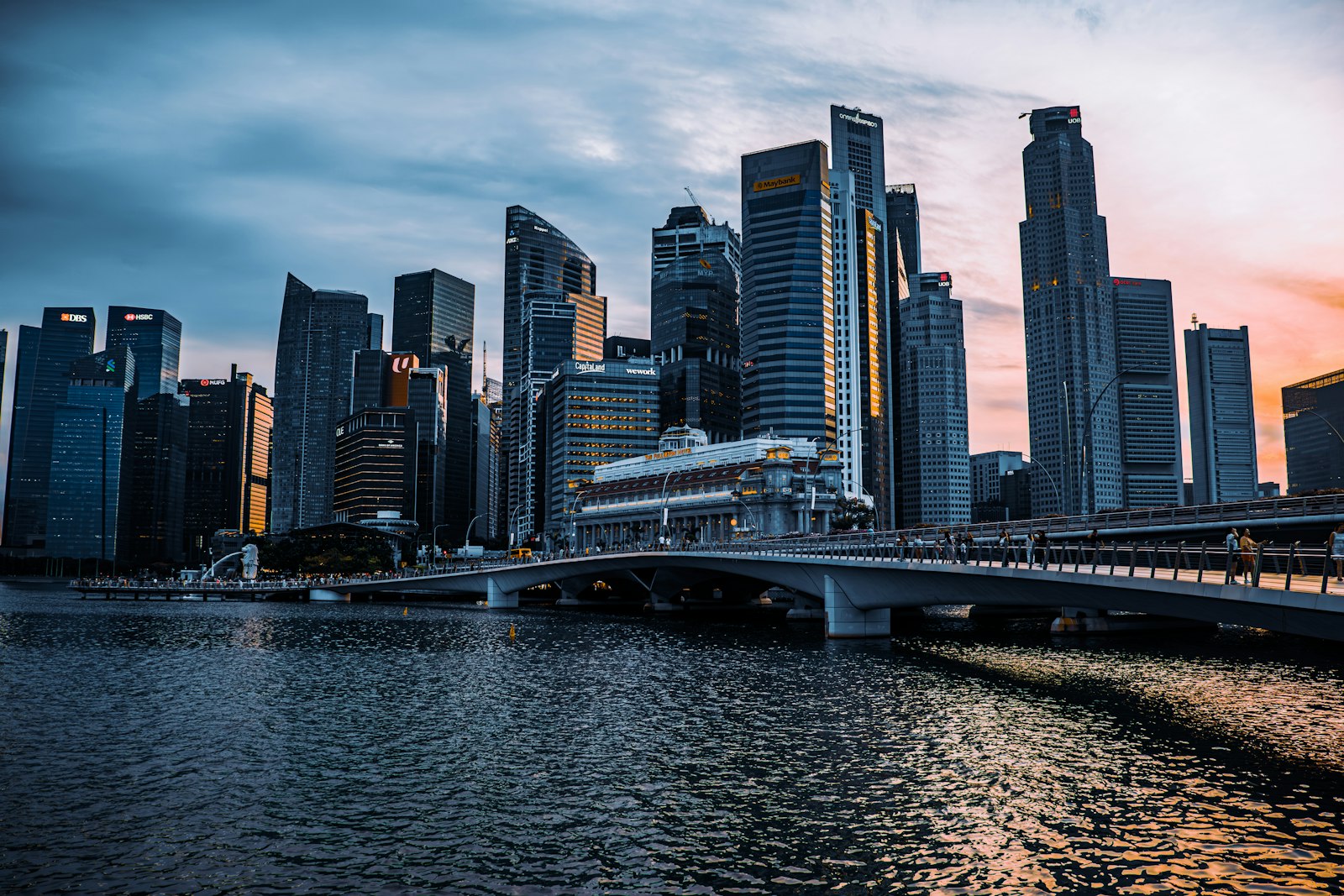
A practical guide to Singapore: how big it really is, hawker centres and what to eat, Gardens by the Bay, getting around by MRT, the weather, entry rules, laws visitors should know and what it costs.
Singapore is an island city-state in Southeast Asia with an area of about 744 square kilometres and a population of roughly 6.1 million in 2025, according to Wikipedia. It has four official languages: English, Malay, Mandarin and Tamil, with English the common language. The currency is the Singapore dollar.
It is small enough that Wikivoyage says you can cross it in barely an hour, yet it packs in one of the world’s busiest ports, a food culture recognised by UNESCO, and some of the most heavily planned green space in any city. It is also easy for first-time Asia visitors: public transport is clear, English is widely used, and Wikivoyage calls it one of the safest major cities in the world.
Our 18-second Short about Singapore is below. For the quick version, see our Singapore travel guide.
Wikipedia describes Singapore as a densely populated city-state, with a density of around 8,290 people per square kilometre, third highest in the world. It is the home of Changi Airport, which opened in 1981, and Wikivoyage calls it one of the world’s most prosperous countries.
The population is mixed, with Chinese, Malay and Indian communities and a large group of workers and expatriates. That shows in the neighbourhoods, temples, mosques and food. The Singapore Botanic Gardens is a UNESCO World Heritage Site.
The city is also known as one of the most expensive in the world. The Economist Intelligence Unit rated it the most expensive city for a third consecutive year in 2016, and that remained true in 2018. Accommodation is the main cost, while food can be cheap if you eat the right way.
Singapore’s hawker culture was inscribed on UNESCO’s Representative List of the Intangible Cultural Heritage of Humanity on 16 December 2020, and UNESCO described hawker centres as “community dining rooms”. Hawker centres grew in the 1950s and 1960s, partly to address unhygienic food preparation by unlicensed street hawkers, and Singapore introduced a demerit point system for food hygiene in 1987.
For visitors the appeal is simple: a wide range of dishes from across Asia under one roof at low prices. Wikivoyage says good hawker food can be found for under US$5 a meal, and 24-hour coffee shops offer the same kind of affordable food.
Some hawker stalls have won Michelin recognition. In 2016 two hawker stalls received stars, and by 2023 hawker stalls made up the majority of the Bib Gourmand list, according to Wikipedia. Queues for famous stalls can be long, so eat outside peak lunch and dinner times.
Tips for hawker centres:
Gardens by the Bay covers 105 hectares in the Central Region next to Marina Reservoir. Bay South Garden opened to the public on 29 June 2012. Its centrepiece is the Supertree Grove, 18 tree-like structures between 25 and 50 metres tall, with an elevated walkway, the OCBC Skyway, between two of them.
Two conservatories require tickets: the Flower Dome, about 1.2 hectares and described as the world’s largest columnless glasshouse, and the Cloud Forest, about 0.8 hectares with a 42-metre mountain and 35-metre waterfall. Wikipedia lists most outdoor areas as free when the gardens opened in 2012, but check the official site for current pricing and show times. The Garden Rhapsody light and music show runs nightly at 7:45 pm and 8:45 pm.
Marina Bay Sands, one of Singapore’s two integrated resorts, sits across the bay. The other is Resorts World Sentosa on Sentosa Island. Both are part of Singapore’s tourism push that began in the 2000s.
Wikipedia lists six MRT lines: North–South, East–West, North East, Circle, Downtown and Thomson–East Coast. Add buses, LRT and taxis, and you can reach most places without a car. Wikivoyage says the system is easy to use, affordable and covers populated areas extensively.
You can tap in with a contactless Visa, Mastercard or American Express. Foreign cards may add a small daily handling fee, and EZ-link and NETS cards are alternatives. Wikivoyage mentions that putting your feet on seats or playing loud music on public transport can mean a fine of S$500.
Walking is pleasant in some districts but hot and humid. Plan indoor breaks, and use covered walkways and underground links, which are common in the city centre.
Singapore has a tropical rainforest climate with no distinct seasons, high humidity and abundant rain. Temperatures usually range from 23 to 32 °C. Wikipedia mentions a wetter monsoon season from November to February, and haze from bush fires in Sumatra often present from July to October.
That means there is no perfect month. If you dislike rain, avoid the monsoon months. If you are sensitive to air quality, check haze forecasts for July to October. Carry a small umbrella at all times, because showers are short and frequent.
Wikivoyage says your passport must be valid for at least six months from arrival. Citizens of the EU, US, UK, Australia and several other countries can stay for 90 days or less without a visa, while citizens of most other countries can stay up to 30 days, and some nationalities need a visa in advance. Arrival-card and customs rules can change, so confirm them on official government sites before you fly.
Singapore enforces its laws strictly. Wikipedia notes the use of caning and capital punishment, and that public gatherings of five or more people require police permits. Wikivoyage adds that police have broader powers than in many Western countries. Check customs rules on what you may bring in before you pack.
The society is socially conservative. Public displays of affection beyond holding hands are frowned on, places of worship require conservative dress, and many ask you to remove your shoes. Singapore is among the safest major cities, but watch for pickpockets in crowds.
Singapore is compact, so you can base yourself almost anywhere and reach the rest by MRT. Marina Bay is the postcard area, with Marina Bay Sands, the waterfront and Gardens by the Bay. Chinatown and Little India show the older, mixed character of the city, with temples, shophouses and food stalls. Orchard Road is the shopping belt.
Sentosa is a smaller island listed among Singapore’s largest offshore islands and home to Resorts World Sentosa. It is the choice for beaches and theme-park style attractions. The Singapore Botanic Gardens, a UNESCO World Heritage Site, is a calmer option and a good place to escape the heat in the morning.
Because the city is hot and humid, plan indoor attractions for the afternoon, and use the MRT to avoid long walks in full sun.
This is our own suggestion, not an official itinerary.
About 744 square kilometres, and Wikivoyage says you can cross it in barely an hour.
There is no distinct season, with temperatures usually 23 to 32 °C. A wetter monsoon season runs from November to February, and haze can occur from July to October.
Accommodation is expensive, and the city has been rated among the world’s most expensive. Food can be cheap: Wikivoyage says good hawker food can be found for under US$5 a meal.
Citizens of the EU, US, UK, Australia and several others can stay 90 days or less without a visa, and citizens of most other countries up to 30 days. Check the official rules for your passport.
Open-air food courts with many stalls. Singapore’s hawker culture was inscribed on UNESCO’s intangible heritage list on 16 December 2020.
By the MRT, buses and taxis. The MRT has six lines, and you can pay by tapping a contactless Visa, Mastercard or American Express.
Wikivoyage calls it one of the safest major cities in the world, although pickpockets can be a risk in crowds. Laws are strictly enforced.
English, Malay, Mandarin and Tamil are official. English is the common language.
Most visitors stay near Marina Bay, Orchard Road or the older districts. Compare prices and reviews, and check the cancellation terms before you reserve.
See stays in Singapore on Booking.com →
Some links on this page are affiliate links. If you book through them, Letsa Atlas may earn a small commission at no extra cost to you.
We checked this guide on November 8, 2026. Entry rules, arrival-card requirements, prices and laws change. Confirm them on official Singapore government sites before you travel. Confirm details with official sources before you go.
Sources checked November 8, 2026: Wikipedia: Singapore · Wikipedia: Gardens by the Bay · Wikipedia: Hawker centre · Wikivoyage: Singapore