A practical guide to Mount Etna and the Taormina coast in Sicily, Italy: how to visit an active volcano safely, when the snow and the beaches overlap, the two ski areas, Taormina, and how to get around.
Mount Etna is on the east coast of Sicily, the large Italian island in the central Mediterranean. It is one of the most active volcanoes in the world, and its summit stands at about 3,403 metres, a figure that changes with eruptions because the craters grow and collapse. UNESCO added Mount Etna to the World Heritage List in 2013.
What makes it special for travellers is the contrast. The coast below is mild and often sunny, with the resort town of Taormina about 45 minutes away by car, while the upper slopes can hold snow in winter and early spring. That is why Etna appears in our Short about places where a beach and snow share a view. It is a real effect, but it depends on the season, the weather and the volcano itself.
For the quick overview, see our Sicily and Mount Etna page. Our Short is below.
Etna erupts often, and recent years show why you should check before you go. Reports from 2024 to 2026 describe eruptions on 14 August 2024, 2 June 2025, 1 January 2026, when activity affected the Valle del Bove side of the volcano, and 6 August 2026, when an eruption at the Voragine crater disrupted flights at Catania airport until about 15 August. These dates come from public reports, and the exact effects differ from one event to the next.
Most Etna eruptions are not dangerous to people who follow the rules, but they can change access very quickly. Cable cars can stop, paths can close, ash can fall on roads and towns, and the airport can pause operations. Treat every plan as flexible and leave a buffer day if you have a flight to catch.
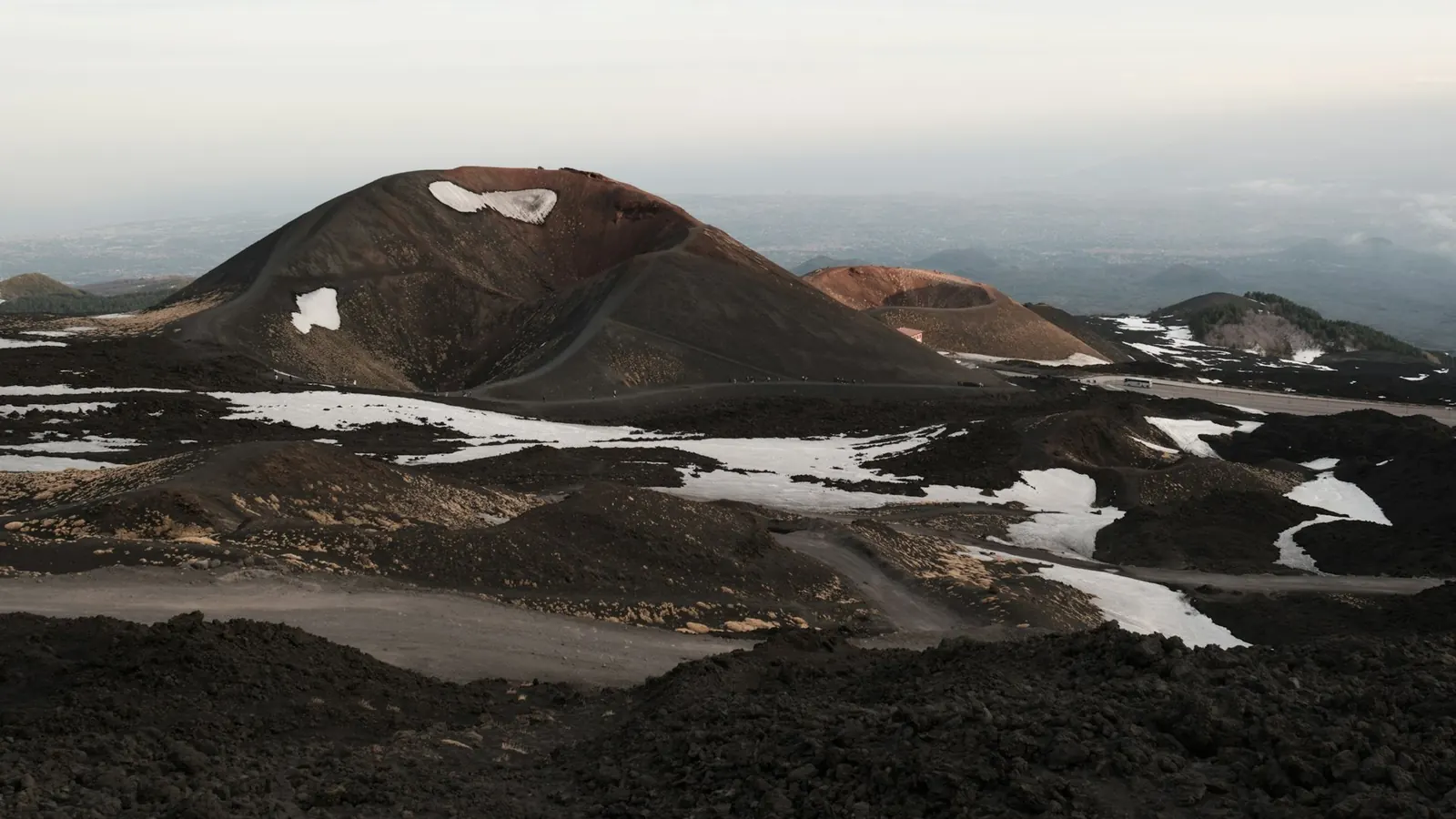
The most common starting point on the south side is the Sapienza area, where a refuge sits at about 1,910 metres. From there, a cable car climbs to about 2,500 metres. You can walk on the surface at that height, see old craters and lava fields, and look out toward the sea on a clear day.
Above about 2,500 metres, visitors need an authorised guide. This is one of the most important rules on the mountain, and it exists because the upper zone is the most exposed to eruptions, gas and sudden weather. Lonely Planet reports that the summit craters themselves have been off limits since August 2024, so you should not expect to stand on the rim. Operators can tell you what the current limit is.
Guided excursions usually offer jeeps, walks and sometimes snowshoes in winter. The experience is different in each season: black volcanic sand and rock in summer, white patches and a harder wind in winter.
Etna has two ski areas. Etna Sud, on the south side near Nicolosi and Sapienza, ranges from about 1,910 to 2,700 metres. Etna Nord, on the north side at Piano Provenzana, ranges from about 1,810 to 2,336 metres. Both can offer views toward the sea, which is the reason they appear on lists of unusual places to ski.
Be realistic about it. Sources disagree on how many lifts run and how many pistes are open, and operations can close for eruption risk or weather. The season is short and depends on snowfall, so treat skiing here as a bonus and not as the whole reason for a trip. Check the operators’ sites before you drive up, and rent equipment locally if you do not travel with your own.
For hiking and general sightseeing, the best months are usually April, May, September and October. The weather is milder, the crowds are smaller than in midsummer, and the paths are clearer. Summer can be hot at the coast and still cool on the mountain, so bring layers even in July.
If you want snow, aim for winter and early spring, from about December to March, with the understanding that snow is never guaranteed on a given day. If you want the “beach and snow in one trip” story, late winter and spring are the best bet: the coast around Taormina is comfortable, and the volcano can still hold snow.
Taormina is a hill town of about 10,000 people, set around 200 metres above the sea. Its main sight is the Ancient Theatre, with a diameter of about 109 metres, which is the second largest in Sicily. From the seats you can look across to Etna and the Ionian Sea.
Below the town, Isola Bella is a small island and nature reserve connected to the shore by a narrow strip of pebbles, and the beaches and cafés of Mazzarò and Giardini Naxos are close. A cable car links Taormina with Mazzarò for a few euros. The Taormina-Giardini railway station is about 2 kilometres below the old town, so plan for a bus or taxi to get up.
The nearest major airport is Catania-Fontanarossa, which serves both Etna and Taormina. After the August 2026 eruption, flights were disrupted for several days, so keep that in mind if you travel in the same season.
A public bus runs from Catania to the Sapienza area in about two hours for a few euros, but the timetable is limited, so check the schedule and the return time. A rental car gives the most freedom, especially if you want to visit more than one side of the volcano, though mountain roads can be slow and are affected by weather. Many visitors choose a guided tour from Catania or Taormina, which removes the driving and handles the guide requirement.
For the sea, the views and the evenings, Taormina is the classic base, though it is a small town with high demand in summer. For Etna and the airport, Catania is the practical base, with a larger choice of hotels, restaurants and transport. Staying in the villages on the slopes, such as Nicolosi, can shorten the morning drive to Sapienza.
Treat Etna like a high mountain that is also a volcano. The weather can change in minutes, temperatures at 2,500 metres can be far lower than at the coast, and the ground is rough lava rock. Wear sturdy shoes, bring a windproof layer and sunglasses, and carry water. Stay on marked paths, follow your guide, and do not go to closed areas.
If you have heart or lung conditions or other health concerns, think carefully about altitude and effort, and speak to a doctor first.
Entry rules depend on your passport. Italy is in the Schengen Area, so check the official Italian rules for your nationality, including whether you need a visa and how long your passport must be valid. If you plan to hire a car, check what licence you need.
This is our own suggestion, not an official itinerary.
About 3,403 metres at the last measurement in 2024. The exact height changes with eruptions.
Yes. It is one of the most active volcanoes in the world, with eruptions reported in 2024, 2025 and 2026.
Above about 2,500 metres you need an authorised guide, and the summit craters have been off limits since August 2024, so check the current rules with an operator.
Yes, in winter and early spring, though snow is not guaranteed on a given day.
Yes, when conditions allow. Etna Sud and Etna Nord are the two ski areas, and both can close for weather or volcanic activity.
April, May, September and October are usually best for hiking. For snow, aim for December to March.
About 45 minutes by car.
Catania-Fontanarossa airport, which was disrupted for several days after the August 2026 eruption.
A public bus runs from Catania to Sapienza in about two hours, but the timetable is limited, so check it before you go.
It depends on your passport. Check the official Italian and Schengen rules for your nationality.
Compare guided tours, day trips and tickets around Taormina, with reviews and free-cancellation options.
Find tours in Taormina on Viator →
Travel insurance. Medical care abroad can be expensive, so many travellers buy cover before they leave. One option is SafetyWing Nomad Insurance. Read the policy wording to see what it covers before you buy.
Taormina is the most popular base for sea views and the coast, and Catania is the practical base for Etna and the airport. Compare prices and reviews, and check the cancellation terms before you reserve.
See stays in Taormina on Booking.com →
Some links on this page are affiliate links. If you book through them, Letsa Atlas may earn a small commission at no extra cost to you.
We checked this guide on November 11, 2026. Volcanic activity, access rules, ski operations, prices and entry rules change quickly. Confirm everything with official volcano updates, the cable car and guide operators, and your own government before you travel. Confirm details with official sources before you go.
Sources checked November 11, 2026: Wikipedia: Mount Etna · UNESCO: Mount Etna · Wikipedia: Taormina · Wikivoyage: Mount Etna · Wikivoyage: Taormina