A practical guide to the Sedlec Ossuary in Kutná Hora: why the chapel is full of bones, who arranged them, what the decoration looks like, how to visit from Prague and what to combine with it.
The Sedlec Ossuary is a small Roman Catholic chapel under the Cemetery Church of All Saints in Sedlec, a suburb of Kutná Hora in the Czech Republic. It is part of the former Sedlec Abbey. It holds the remains of an estimated 40,000 to 70,000 people, and many of the bones have been arranged as decoration.
More than 200,000 people visit each year, which makes it one of the most visited attractions in the Czech Republic. The visit itself is short, often under an hour, so the real planning questions are how to reach Kutná Hora and what to combine with it.
Our short video about the ossuary is below. For the quick version of this page, see our Sedlec Ossuary travel guide.
In 1278 Henry, abbot of the Cistercian monastery at Sedlec, brought back a small amount of earth from Golgotha from the Holy Land and sprinkled it over the abbey cemetery. The story made the cemetery a desirable burial site throughout Central Europe, and people from far away wanted to be buried there.
Two later events enlarged it further. Burials during the Black Death in the middle of the 14th century, and after the Hussite Wars in the early 15th century, forced the cemetery to be greatly enlarged. Around 1400 a Gothic church with a lower ossuary chapel was built to hold bones that had been dug up to make room for new burials. According to legend, a half-blind monk began stacking the bones after 1511.
The chapel was rebuilt in the Baroque style in 1703 to 1710, to a design by Jan Santini Aichel. In 1870 the woodcarver František Rint, who was employed by the Schwarzenberg family, arranged the heaps of bones into the decoration you see today. His signature, made of bone, is near the entrance.
The decoration includes a chandelier that contains at least one of every bone in the human body, garlands of skulls on the vault, four bell-shaped mounds in the corners, monstrances beside the altar and a Schwarzenberg coat of arms made of bones. Our video describes it as a church decorated with about 40,000 skeletons, which fits the estimate that the remains of 40,000 to 70,000 people are there.
The visit is mostly about looking up and around. The chandelier hangs at the center of the chapel, and the garlands of skulls run along the vault. The four large mounds in the corners are shaped like bells and built of stacked bones.
Remember that these are human remains. Photography rules and behavior rules can apply, so follow the signs and staff instructions.
Kutná Hora lies east of Prague, and the ossuary in Sedlec is a suburb of the town. Most visitors treat it as a day trip from Prague by train, followed by a short onward walk, bus or taxi to Sedlec. Timetables and journey times change, so check them for the day you travel.
If you start early, you can see the ossuary first, before groups arrive, and then continue to the historic center of Kutná Hora, which is a UNESCO World Heritage Site, in the afternoon.
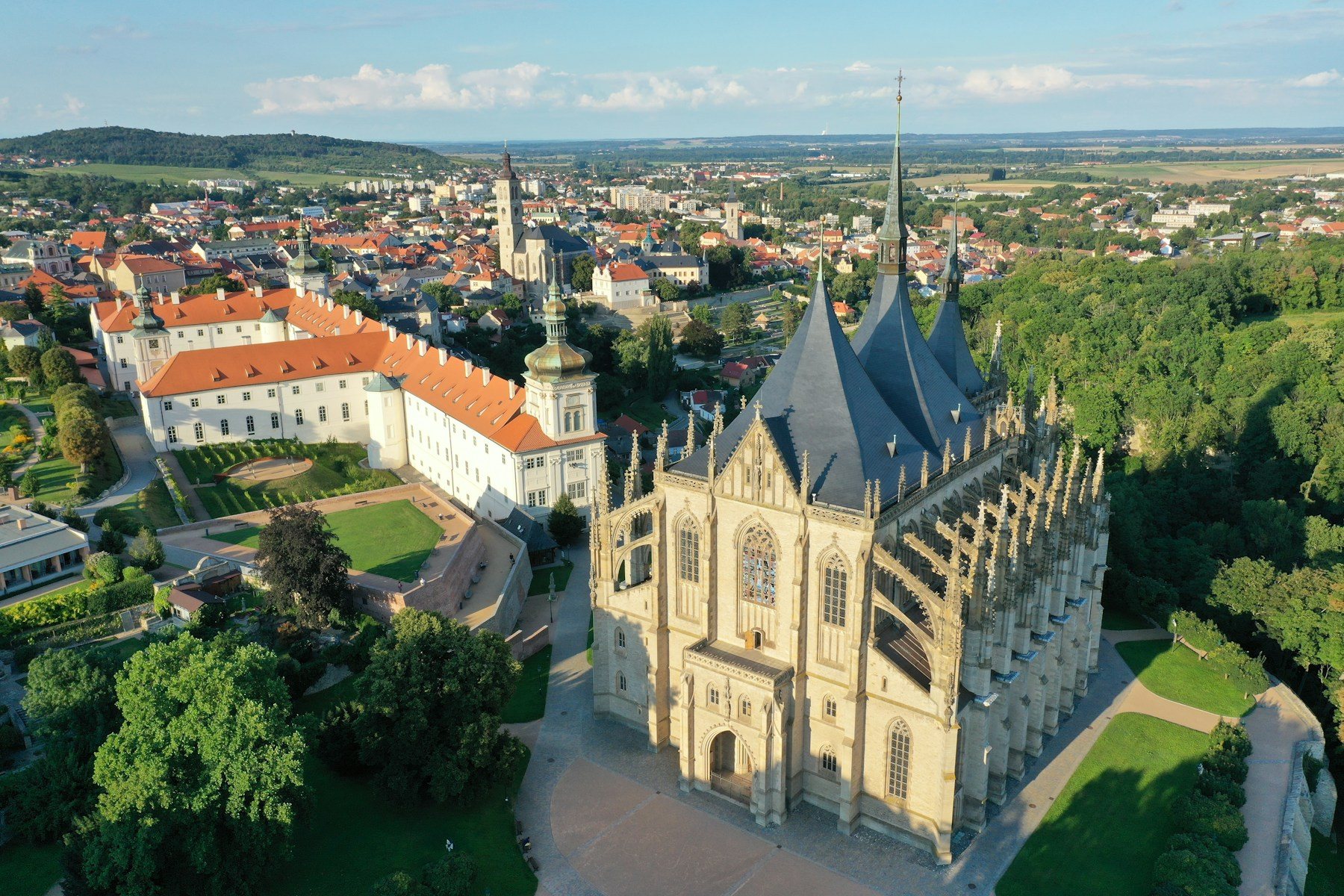
The historic town of Kutná Hora is a UNESCO World Heritage Site, and St. Barbara’s Cathedral is a main sight in the center. Many visitors combine the ossuary with the cathedral and a walk through the old town, which makes a full day.
The ossuary is the strongest reason to come, but the town gives the trip a wider shape. If you have time, add a meal in the center before returning to Prague.
In 1970 the filmmaker Jan Švankmajer made a film about the ossuary, which the Czech Communist authorities initially banned. The chapel has long attracted artists, writers and photographers, and its image is common in books about unusual places.
That attention is one reason for the high visitor numbers. Plan for crowds in the middle of the day, especially in summer and around holidays.
The figure of 40,000 to 70,000 people comes from estimates, which is why our video rounds it to about 40,000. The cemetery was enlarged because of epidemics and wars, and the bones were dug up and stored in the ossuary to make room for new burials. Over centuries that storage became the collection that Rint arranged in 1870.
More than 200,000 visitors a year means that the chapel sees about 550 people on an average day, though numbers are much higher in summer. Plan your visit around that rhythm, and expect a calmer experience early in the morning.
This is our own suggestion, not an official itinerary.
Opening hours and ticket prices change by season, so check the official site before you go. Treat it as a religious site and avoid loud behavior inside the chapel. Small change is useful for tickets and local transport.
A visit to the ossuary alone can be short, so the main cost is travel time. A full day from Prague is a comfortable plan.
The ossuary is open throughout the year, although hours change by season. Weekday mornings are usually the quietest, and early in the day you will have a better chance of seeing the chapel without a crowd. Summer weekends and holidays are the busiest.
If you travel in winter, check the opening hours carefully, since the chapel and the town can have shorter days.
In Sedlec, a suburb of Kutná Hora in the Czech Republic. It is a chapel under the Cemetery Church of All Saints.
An estimated 40,000 to 70,000 people.
The woodcarver František Rint, employed by the Schwarzenberg family, in 1870.
Bones. It contains at least one of every bone in the human body.
Abbot Henry sprinkled earth from Golgotha over the cemetery in 1278, making it a popular burial site, and the Black Death and the Hussite Wars filled it further.
Most people take a train to Kutná Hora as a day trip, then continue to Sedlec. Check timetables for the day you travel.
More than 200,000.
The chapel itself is a short visit, often under an hour. Many people combine it with the town center for a full day.
Most visitors see the ossuary as a day trip from Prague, but Kutná Hora itself has hotels and guesthouses if you prefer a quieter evening. Compare prices and reviews, and check the cancellation terms before you reserve.
See stays in Kutná Hora on Booking.com →
Some links on this page are affiliate links. If you book through them, Letsa Atlas may earn a small commission at no extra cost to you.
We checked this guide on November 10, 2026. Opening hours, ticket prices and timetables change, so confirm them with the official sites before you go. Confirm details with official sources before you go.
Sources checked November 10, 2026: Wikipedia: Sedlec Ossuary · Kutná Hora tourism