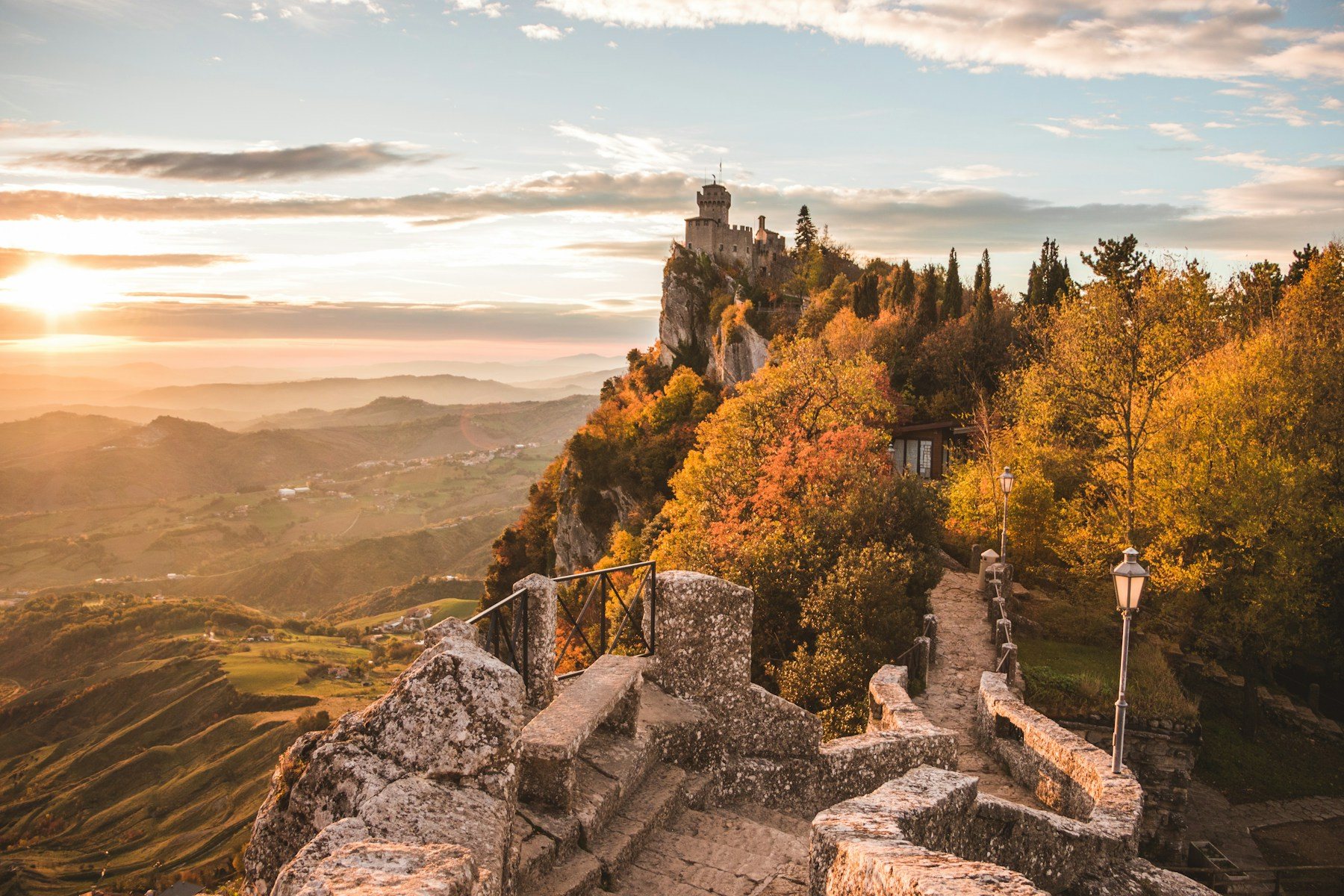
A practical guide to San Marino: how to reach it from the Italian coast, what to see on Monte Titano, how the six-month government works, what to spend and how long to stay.
San Marino is a republic of 61.19 square kilometers, completely surrounded by Italy. It had about 34,042 residents in 2025. Tradition says it was founded on 3 September 301 by Saint Marinus, and it is usually described as the oldest surviving republic. Its borders have not changed since 1463.
For a visitor, it is a mountain trip. The historic center and the three medieval towers sit on Monte Titano, 749 meters above sea level, and most people see them in a day. The real planning questions are how to get there, because there is no airport or railway, and how to avoid the steepest climbs.
Our short video about San Marino is below. For the quick version of this page, see our San Marino travel guide.
The state is led by two Captains Regent, elected to serve for six months. They take office on 1 April and 1 October. Its Statutes date from 8 October 1600, and the republic has kept its independence for well over a thousand years by tradition.
One story people often tell is that in 1797 Napoleon offered to extend San Marino’s territory, and the regents declined. For visitors, the point is that the country still feels like a small, self-governing town: its institutions sit in a few streets, and you can walk past them in an afternoon.
San Marino uses the euro and is able to issue its own euro coins, including gold scudi. Italian is the language in use. There are no border formalities with Italy, although the tourist office offers souvenir passport stamps if you want one.
San Marino has no airport and no railway apart from an 800-meter heritage line. The nearest airports are Rimini, Forlì, Ancona and Bologna, and the most common route is by coach from Rimini, which takes about 50 minutes.
That makes Rimini the practical gateway. You can fly to Rimini or reach it by train along the Adriatic coast, then take the coach up to San Marino. If you arrive by car, expect parking to be a main concern on the mountain, because the old town is largely pedestrian.
Tradition dates the founding of San Marino to 3 September 301, when Saint Marinus is said to have founded a community on Monte Titano. The republic celebrates that date, and it is the reason the country is often called the oldest surviving republic in the world.
The Statutes of 1600, dated 8 October, are the written basis of its constitutional life. Over the centuries the territory grew in stages, and its borders have been fixed since 1463, which means the shape you see on a modern map is more than five hundred years old.
The story most visitors remember is from 1797, when Napoleon offered to extend the territory and the regents declined. Whether you treat it as history or local pride, it explains why the country still presents itself as small on purpose. The government’s six-month rhythm, with new Captains Regent on 1 April and 1 October, is a living reminder of the same tradition.
San Marino is an enclave: Italy is on every side. That affects your trip in simple ways. You will cross the border without any formalities, you will use the euro on both sides, and Italian is the language you hear in the street. The landscape around the mountain is the Italian countryside, and the views from the towers look out over it.
It also means that planning is Italian planning. The airports that serve you, Rimini, Forlì, Ancona and Bologna, are all in Italy, and the coach you take from Rimini is an Italian-side connection. Treat San Marino as one stop in a wider trip through the region rather than a destination you reach in isolation, and the logistics become much easier.
Almost everything worth seeing is on or near the ridge of Monte Titano.
Plan a few hours for the three towers and the walk between them. Some towers and museums have seasonal hours, so check before you set your day.
The Funivia connects Borgo Maggiore with the historic center in about two minutes. It carries around 500,000 passengers a year, which gives you a sense of how many visitors use it. For many people it is the easiest way to reach the top, and it removes a steep climb on foot.
If you drive, you can park in the lower town and take the cable car up, which keeps the old town free of traffic. If you come by coach from Rimini, you will usually be dropped near the top.
Tourism accounts for more than 22 percent of GDP. San Marino received about two million tourists in 2014, with an average stay of two nights. Most visitors come for a day, which is why the old town feels busy at midday and calmer in the early morning and evening.
The euro is the currency. Because the country is small and its economy is built around visitors, you should expect tourist prices in the center. Eating a little off the main street is the simplest way to keep costs down.
This is our own suggestion, built from the distances above, not an official itinerary.
San Marino sits on a mountain, so the weather can differ from the coast. Check the forecast before you go, and bring a layer in cooler months. Summer is the busiest season, and the early morning is the best time to see the towers without the crowds.
If you prefer fewer people, choose a weekday outside the main summer weeks. Opening hours for the towers and museums can change by season, so confirm them on the official site.
One day is enough for the towers and the old town. The average stay in the count above was about two nights, which suggests that many visitors add a second day, usually to enjoy the evening quiet and the views. If you stay longer, you can combine San Marino with the Adriatic coast, since Rimini is under an hour away by coach.
Yes. It is a sovereign republic of 61.19 square kilometers, completely surrounded by Italy.
There are no border formalities with Italy, but you should carry ID. The tourist office offers souvenir passport stamps.
Most visitors take a coach from Rimini, which takes about 50 minutes. San Marino has no airport and no railway.
The euro. San Marino can also issue its own euro coins.
Two Captains Regent, who serve for six months and take office on 1 April and 1 October.
Guaita, Cesta and Montale, on the ridge of Monte Titano, part of the UNESCO listing of 2008.
One day covers the towers and the old town. Many visitors stay about two nights.
The record says Napoleon offered to extend its territory in 1797 and the regents declined.
San Marino is small and has few beds compared with the Italian coast, so many visitors stay in the historic center for the setting, or in Rimini for the price and the transport. Compare prices and reviews, and check the cancellation terms before you reserve.
See stays in San Marino on Booking.com →
Some links on this page are affiliate links. If you book through them, Letsa Atlas may earn a small commission at no extra cost to you.
We checked this guide on November 10, 2026. Opening hours, ticket prices and bus timetables change, so confirm them with the official tourism site before you go. Confirm details with official sources before you go.
Sources checked November 10, 2026: Wikipedia: San Marino · Wikipedia: Three Towers of San Marino · San Marino tourism