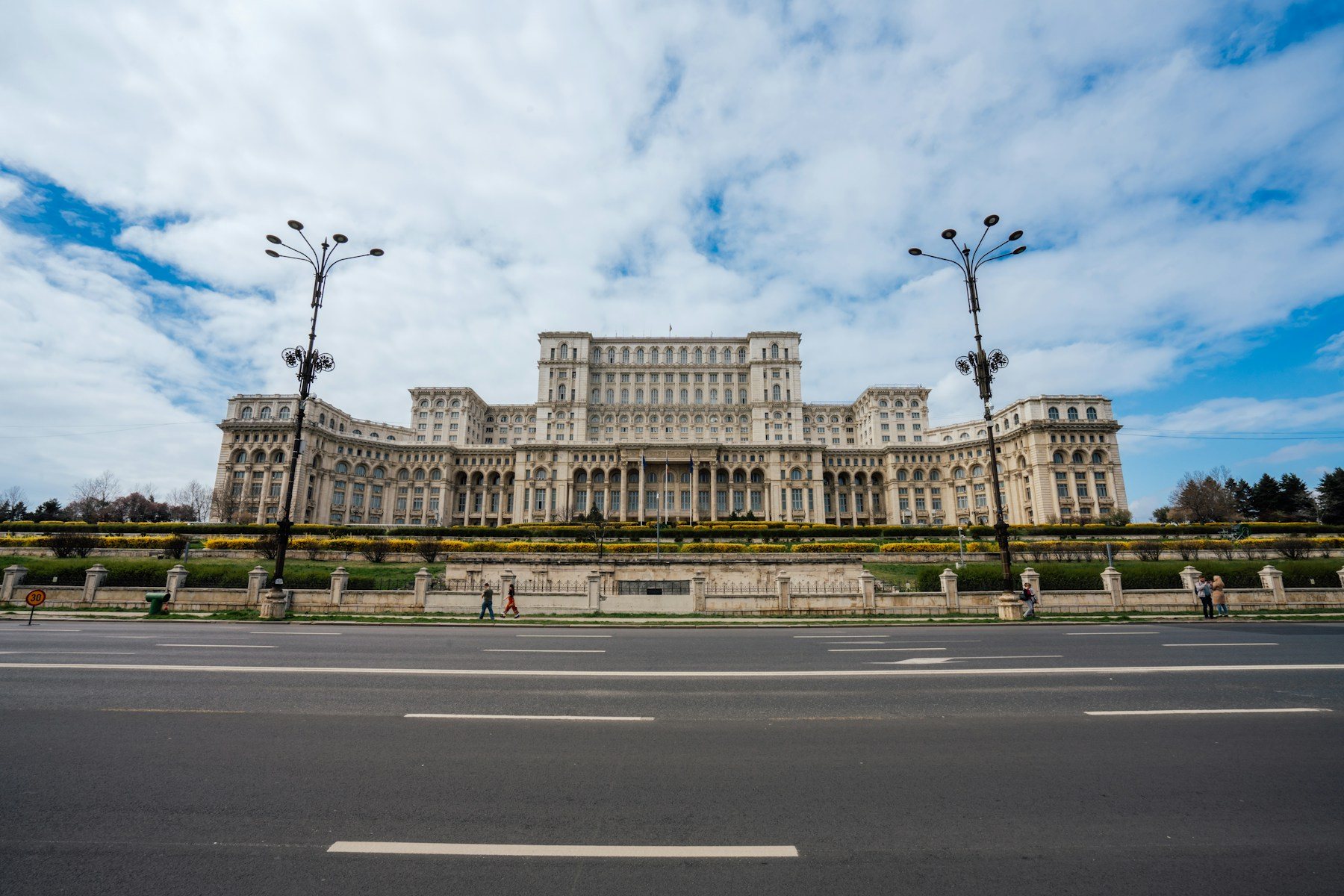
A practical guide to the heaviest building on Earth: how it was built, what the numbers mean, what is inside today and how to visit it in Bucharest.
The Palace of the Parliament is a government building in Bucharest, Romania, at Strada Izvor 2-4, on a rise called Arsenal Hill at the west end of Bulevardul Unirii. It was commissioned by Nicolae Ceaușescu, the president of Communist Romania. Groundbreaking was on 25 June 1984 and construction ran through 1997.
It has 365,000 square meters of floor area, 12 floors above ground, eight underground levels and about 1,100 rooms, of which about 400 were finished and in use as of 2013. It weighs about 4,098,500 tonnes, which is the claim behind our video: it is described as the heaviest building in the world.
Our short video about the palace is below. For the quick version of this page, see our Palace of the Parliament travel guide.
The palace is 240 meters long and 270 meters wide, rises 84 meters above ground and reaches 92 meters deep underground. The volume is about 2,550,000 cubic meters, which exceeds the Great Pyramid of Giza by about 2 percent, and the grounds cover 66,000 square meters.
By floor area it is the third-largest administrative building in the world, after the Pentagon and the Sappaya-Sapasathan in Thailand. It is the largest civilian administrative building, and the Pentagon is larger but is a military one. That is the difference to keep in mind when you see “biggest building” claims: they depend on how the category is defined.
The chief architect was Anca Petrescu, who supervised about 700 architects. Between 20,000 and 100,000 people worked on the project, and official data reports 27 deaths during construction, although workers have claimed far higher numbers. The cost was about €4 billion as of 2020, making it the most expensive administrative building in the world. Earlier estimates were US$1.75 billion in 1989 and US$3 billion in 2006.
To make space, about 7 square kilometers of the old city center was demolished and about 40,000 people were relocated. The Uranus Hill was leveled, the Uranus-Izvor neighborhood was destroyed, and about 37 old factories and workshops stood in the area. This is the part of the story that makes the building controversial in Romania, and it is why it is worth visiting with some context.
The building is in use. The Chamber of Deputies has been housed there since 1994 and the Senate since 2004. The Constitutional Court is also located there. The National Museum of Contemporary Art opened inside in 2004, and there is a museum of the palace and an international conference center that hosts conferences and symposia.
About 70 percent of the building remains empty. That is partly why the palace is both impressive and strangely quiet: only a fraction of its 1,100 rooms are used.
Because parts of the building are used by Parliament, visits are usually organized as guided tours, and only part of the building is open to the public. Rules on booking, ID and photography can change, so check the official visitor pages before you go and book ahead for busy days.
Allow time to walk around the outside, too. The palace faces a long boulevard, and the scale is easier to understand from the street than from any single photo.
The palace stands at the west end of Bulevardul Unirii, which was built as part of the same project. Walking along the boulevard is a good way to see the scale of the plan. From there, the old town is within reach, and many visitors combine the palace with a walk through the historic center.
Because the palace is a long visit and a short walk from central areas, you can fit it into a half day and use the rest of the day for the old town.
Records about this building depend on what is measured. The weight of about 4,098,500 tonnes is the figure behind the heaviest building claim. The floor area of 365,000 square meters ranks it third among administrative buildings, behind the Pentagon and the Sappaya-Sapasathan. The volume of about 2,550,000 cubic meters is what exceeds the Great Pyramid of Giza by about 2 percent. Each claim is true in its own category, and none of them means it is the largest building of every kind.
When you hear the building described as the biggest in the world, ask which measure is meant. The most defensible claims are heaviest building and largest civilian administrative building, and those are the two we use. Understanding that makes the tour more interesting, because the guide’s numbers will line up with the categories above, and you will know why some sources say third-largest and others say largest.
This is our own suggestion, not an official itinerary.
The palace was built during the last years of the Ceaușescu era, and it was still unfinished when his government fell. That is why only about 400 of its 1,100 rooms were in use as of 2013. For visitors, it is both an architectural record and a reminder of the human cost of the project.
It is worth reading a little about the history before you go, since the tour focuses on rooms and numbers and the demolition is only one part of the story.
Tour prices and conditions change, so check the official site. Bring the ID the rules require, and arrive early for security checks. Because it is a working government building, parts of it may close for official events with little notice.
The palace is in the center of Bucharest, so you can reach it on foot from many hotels, or by public transport.
The building can be visited throughout the year. Weekday mornings are usually calmer, and summer weekends can be busier. Because tours are guided, the time of day matters less for crowds than for booking availability, so book ahead.
Yes. It weighs about 4,098,500 tonnes and is described as the heaviest building in the world.
It is the largest civilian administrative building. The Pentagon is larger, but it is a military administrative building.
It was commissioned by Nicolae Ceaușescu, and the chief architect was Anca Petrescu. Construction ran from 1984 to 1997.
About 1,100, of which about 400 were finished and in use as of 2013.
The Chamber of Deputies, the Senate, the Constitutional Court and the National Museum of Contemporary Art, plus a conference center.
About €4 billion as of 2020.
Yes, usually by guided tour. Check the official pages for booking and ID rules.
About 70 percent.
The palace is in central Bucharest, so a hotel in the city center keeps the visit, the old town and the main boulevards within reach. Compare prices and reviews, and check the cancellation terms before you reserve.
See stays in Bucharest on Booking.com →
Some links on this page are affiliate links. If you book through them, Letsa Atlas may earn a small commission at no extra cost to you.
We checked this guide on November 10, 2026. Tour rules, ID requirements and opening hours change, so confirm them with the official visitor pages before you go. Confirm details with official sources before you go.
Sources checked November 10, 2026: Wikipedia: Palace of the Parliament · Palace of the Parliament visits