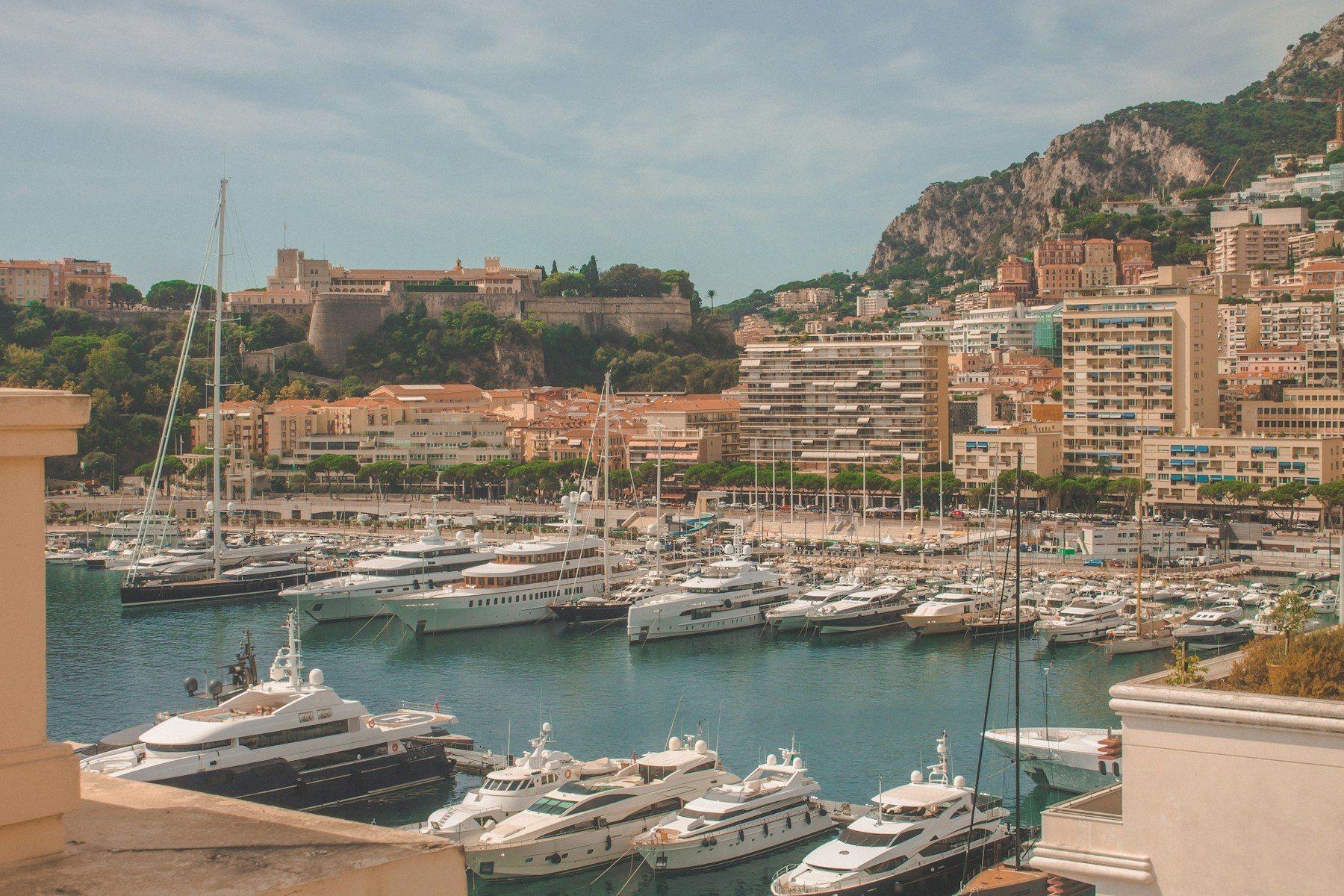
A practical guide to Monaco: how to reach it from Nice, what to see in Monte Carlo and the old town, how the Grand Prix changes the city, how the tax rules work and when the weather is best.
Monaco is a city-state on the French Riviera covering 2.08 square kilometers, including its newest district, Le Portier. It had 38,857 residents at the 2025 census and has the highest population density of any country, about 18,446 people per square kilometer. Its coastline is 3.83 kilometers, the shortest of any country with a coast.
For a visitor, that means a very compact trip. You can cross the principality on foot, and most of what people come to see, the harbor, the casino, the palace and the oceanographic museum, sits within a short distance of each other. The real planning questions are about timing and cost, because Monaco closes streets for events and prices are high.
Our short video about Monaco is below. For the quick version of this page, see our Monaco travel guide.
Monaco has about 5.47 kilometers of land border with France on its north, east and west sides, and there have been no border formalities since 1963. You do not pass a checkpoint when you arrive by train or road. French is the official language, Italian is widely spoken, and Monégasque, a Ligurian variety, is traditional but not official. English is also used.
The currency is the euro, through an arrangement with France. Monaco is not a member of the European Union, but it is part of the EU customs territory. For most visitors the practical effect is simple: you pay in euros and cross freely from France.
The principality has no personal income tax for residents, except French citizens, who must still pay income and wealth taxes to France. Corporate tax is 33 percent unless at least 75 percent of turnover is generated in Monaco, and value added tax is 20 percent. That tax setup is why Monaco appears in so many money stories, but as a visitor you will mainly notice that prices are high.
The Monaco-Monte Carlo station is on the Marseille–Ventimiglia railway, with connections to Nice, Cannes and Marseille. Nice Côte d’Azur Airport is a little under an hour away. The Monaco Heliport offers helicopter service to Nice airport for those who want it.
For most budgets, Nice is the practical gateway: you fly into Nice and take the train along the coast. The line follows the sea, so the ride is part of the trip. Trains and local buses connect the towns of the Riviera, so a day trip from Nice or a nearby town is easy to plan.
Monaco is divided into quarters, and the two most visited are Monte Carlo and Monaco-Ville.
Because the principality is so small, you can see all four areas in one day. The hills are steep, so allow for walking uphill between the harbor and the old town.
The Monaco Grand Prix has been held since 1929 on the temporary Circuit de Monaco in Monte Carlo and has been on the Formula One calendar since 1950. The circuit is 3.337 kilometers long, the race runs 78 laps for a total of 260.286 kilometers, and it is the only Grand Prix that does not meet the FIA’s 305-kilometer minimum race distance.
The race is usually held in late May or early June, and from 2026 it moves to the first weekend of June. Erecting the circuit takes six weeks, and taking it down takes three, which means parts of the city are affected for weeks around the race. Temporary grandstands are mostly around the harbor, and balconies and boats are also used as viewing spots.
If you want to avoid the crowds and the highest hotel prices, plan your trip for a different week. If you want to see the race, book accommodation and tickets well ahead and check the official pages for dates and rules.
Monaco has a hot-summer Mediterranean climate with mild, rainy winters. The average annual daily maximum is 19.2 °C, annual precipitation is about 743.6 millimeters, and the principality gets about 2,575 hours of sunshine per year. Summer temperatures above 30 °C are rare, and winter frost and snow are extremely rare.
That makes Monaco comfortable for much of the year. Spring and early autumn are good choices if you want to walk the hills without the heat and avoid the highest prices of the Grand Prix period. Winter is quieter, and while it is mild, it is also the rainier season.
Monaco has almost no room to grow inland, so it has extended its land into the Mediterranean. Le Portier, a roughly six-hectare district, opened in December 2024, and a further eight-hectare extension of Fontvieille has been approved. For visitors this means the coastline and the skyline keep changing, and some areas near the water may be construction sites when you visit.
The result is a city where almost every square meter is used. Streets are narrow, buildings are tall, and a lot of Monaco’s life happens in tunnels, lifts and public escalators that link the levels of the hillside. When you plan your day, allow time for steep walks and use the public lifts where they exist.
The Monaco-Monte Carlo station is on the Marseille–Ventimiglia railway, so you can reach Nice, Cannes and Marseille westward and the Italian border town of Ventimiglia eastward. Many visitors treat Monaco as a half-day or one-day stop between Nice and Italy rather than as a base.
If you are traveling along the Riviera, a simple rhythm is to base yourself in Nice, take the train to Monaco for the morning, and return in the afternoon. This keeps your costs lower than staying in Monaco itself, and it gives you more choice of restaurants and hotels.
This is our own suggestion, built from the distances and facts above, not an official itinerary.
Monaco is expensive, and tourists should plan accordingly. About 300,000 international tourist arrivals were recorded in 2022, a small number compared with the Riviera as a whole, because many visitors come as day trips. A sensible way to keep costs down is to stay in a nearby town and visit Monaco for the day.
The euro is the currency, VAT is 20 percent, and there are no border controls with France. Because rules at casinos and for events can change, check the official sites for dress codes, age limits and opening hours before you go.
Yes. It is a sovereign city-state on the French Riviera, covering 2.08 square kilometers.
There have been no border formalities with France since 1963. Carry ID in case, since rules for your passport can differ and Monaco is not in the EU.
No. It uses the euro, through an arrangement with France.
Residents pay no personal income tax, except French citizens, who must still pay income and wealth taxes to France. VAT is 20 percent.
Most people take the train from Nice or Cannes to Monaco-Monte Carlo station. Nice Côte d’Azur Airport is a little under an hour away.
Usually in late May or early June. From 2026 it moves to the first weekend of June.
The 2025 census counted 38,857 residents. The density of about 18,446 people per square kilometer is the highest of any country.
One day is enough to see Monte Carlo, Monaco-Ville and the Oceanographic Museum. Stay overnight only if you want the experience.
Monaco is expensive and small, so many visitors choose a base in Monaco itself for the experience, or in nearby towns for the price. Compare prices and reviews, and check the cancellation terms before you reserve.
See stays in Monaco on Booking.com →
Some links on this page are affiliate links. If you book through them, Letsa Atlas may earn a small commission at no extra cost to you.
We checked this guide on November 10, 2026. Prices, opening hours and event dates change, and Monaco’s streets close for the Grand Prix and other events, so confirm everything with the official tourism site. Confirm details with official sources before you go.
Sources checked November 10, 2026: Wikipedia: Monaco · Wikipedia: Monaco Grand Prix · Visit Monaco