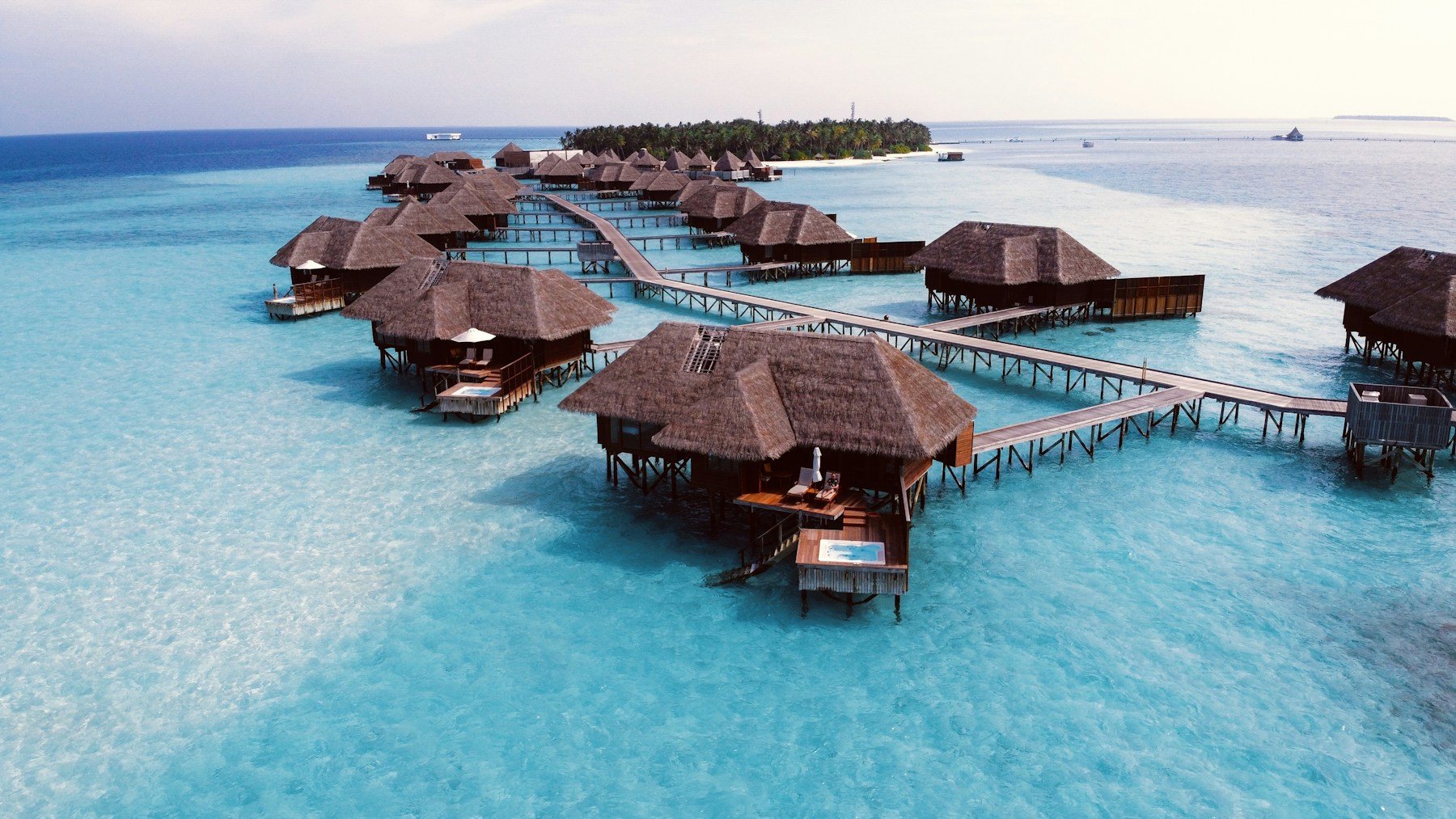
A practical guide to the Maldives: how to get from the airport to your island, how resorts and local islands differ, what entry rules to expect, when to go and why the sea level matters here more than anywhere.
The Maldives has 1,192 coral islands in 26 atolls, but the land of all of them added together covers only 298 square kilometers, spread across about 90,000 square kilometers of the Indian Ocean. About 200 islands are inhabited. The population was 515,132 in the 2022 census, and the capital Malé holds about 41 percent of it.
For a visitor, that means a trip that is mostly about water: you arrive at one airport, then move by seaplane, boat or short domestic flight to a single small island. The planning questions are which kind of island to choose, how to get there, and which season suits you.
Our short video about the Maldives is below. For the quick version of this page, see our Maldives travel guide.
Malé is the capital and most populous city, and the main airport, Velana International, is on Hulhulé Island next to it, linked by the Sinamalé Bridge. The official language is Dhivehi, written in the Thaana script, and English is widely spoken. The currency is the Maldivian rufiyaa.
Sunni Islam is the official state religion, and the constitution says the country is based on Islamic principles. Open practice of other religions is forbidden. Most resort islands operate under different conditions from local islands, so what is normal at a resort may not be on an inhabited island. If you plan to stay on a local island, read the current rules on dress and behavior before you go.
Almost every trip starts at Velana International Airport. From there you continue by seaplane, domestic flight, speedboat or dhoni, the slower and cheaper traditional boat. Seaplanes are operated by TMA, which flies DHC-6 Twin Otters and merged with Maldivian Air Taxi in 2013, and by Manta Air, which began scheduled seaplane service in 2019.
Distance and time of day decide the choice. Many resorts arrange the transfer for you and include it in the price, while local islands are usually reached by public ferry or speedboat. Seaplanes generally fly in daylight, so a late arrival can mean a night in Malé or on Hulhulé before you continue.
For most visitors, no visa is required before arrival, regardless of nationality. You need a passport valid for at least one month, a confirmed itinerary with onward travel, proof of funds and a Traveller Declaration form submitted within 96 hours of arrival. A yellow fever certificate is required if you are coming from an affected country.
Entry rules can change, and some nationalities are restricted: Israeli passport holders have been denied entry since a June 2024 cabinet decision. Check the official immigration pages for your own passport before you book flights.
The first Maldivian resort, Kurumba, opened in 1972. By 2007 there were 92 resorts, and in 2008 the 89 resorts then open offered more than 17,000 beds and hosted about 600,000 tourists a year. Visitor numbers passed 1.7 million in 2019, and tourism is about 28 percent of GDP and more than 60 percent of foreign exchange receipts.
A resort island is usually private, with one resort per island, a house reef and transfers included. A local island is a community with its own shops and mosque, and guesthouses there are generally cheaper but come with local rules. Neither is better: choose resorts for privacy and diving at the door, and local islands for lower costs and daily life.
The Maldives has two monsoon seasons. The dry season comes with the northeast monsoon in the winter months, and the rainy season comes with the southwest monsoon, which runs from early June to late November. Average highs are about 31.5 °C and lows about 26.4 °C, so temperatures are warm all year. Rainfall averages about 254 centimeters in the north and 381 centimeters in the south.
If you want the most settled weather, aim for the dry season, which is also the busiest and most expensive. The rainy season can bring cheaper rooms but more cloud and wind, and sea conditions can affect transfers.
The average elevation is about 1.5 meters above sea level, and the highest natural point is 2.4 meters. More than 80 percent of the islands rise less than one meter. The IPCC warned that at current rates the Maldives could be uninhabitable by 2100. Our video quotes projections that up to 80 percent of the country could become uninhabitable by 2050, which is a worst-case figure: treat the exact date as uncertain, and the direction as clear.
For a visitor this is context rather than a danger. You will see seawalls, land reclamation and artificial islands, which are part of how the country adapts. It is a good reason to choose operators that take reef protection and waste seriously.
Malé is the most populous city, and about 41 percent of residents lived there in 2022, up from 27 percent in 2000. It is a dense city on a small island, close to the airport on Hulhulé, and the bridge between them makes the capital an easy stop at the start or end of a trip. If you have a long layover or a late flight, a few hours in Malé gives you a look at everyday Maldivian life that resorts do not show.
Because land is so scarce, the capital region has grown by building outward and by reclaiming land from the lagoon. It is a small preview of how the whole country manages limited space: every plot of land has a use, and most of the country’s population lives on a few of its islands.
This is our own suggestion, not an official itinerary.
The currency is the rufiyaa, and many resort prices may be quoted in other currencies, so check which one applies to you. A resort stay is the most expensive way to visit, because food, transfers and activities all come at resort prices. Local islands and guesthouses cost much less, but you accept local rules and fewer facilities.
Whichever you choose, ask what is included before you pay, since transfers can be a large part of the total.
1,192 coral islands in 26 atolls, with about 200 inhabited.
The land area is 298 square kilometers, spread across about 90,000 square kilometers of sea.
Most visitors need no visa before arrival, but you need a valid passport, onward travel, proof of funds and a Traveller Declaration within 96 hours of arrival.
The dry season, during the northeast monsoon in winter. The rainy southwest monsoon runs from early June to late November.
By seaplane, domestic flight or speedboat, depending on the distance. Local islands are often reached by ferry or dhoni.
The average elevation is about 1.5 meters. The IPCC warned it could be uninhabitable by 2100 at current rates.
The Maldivian rufiyaa, although resorts may quote prices in other currencies.
Sunni Islam is the state religion, and rules on dress and behavior differ outside resorts.
In the Maldives, where you sleep decides your whole trip: a private resort island, a guesthouse on a local island or a stay in Malé each give a very different experience and price. Compare prices and reviews, and check the cancellation terms before you reserve.
See stays in Maldives on Booking.com →
Some links on this page are affiliate links. If you book through them, Letsa Atlas may earn a small commission at no extra cost to you.
We checked this guide on November 10, 2026. Entry rules, island regulations and prices change, so confirm them with the official tourism board and your accommodation before you go. Confirm details with official sources before you go.
Sources checked November 10, 2026: Wikipedia: Maldives · Maldives tourism board