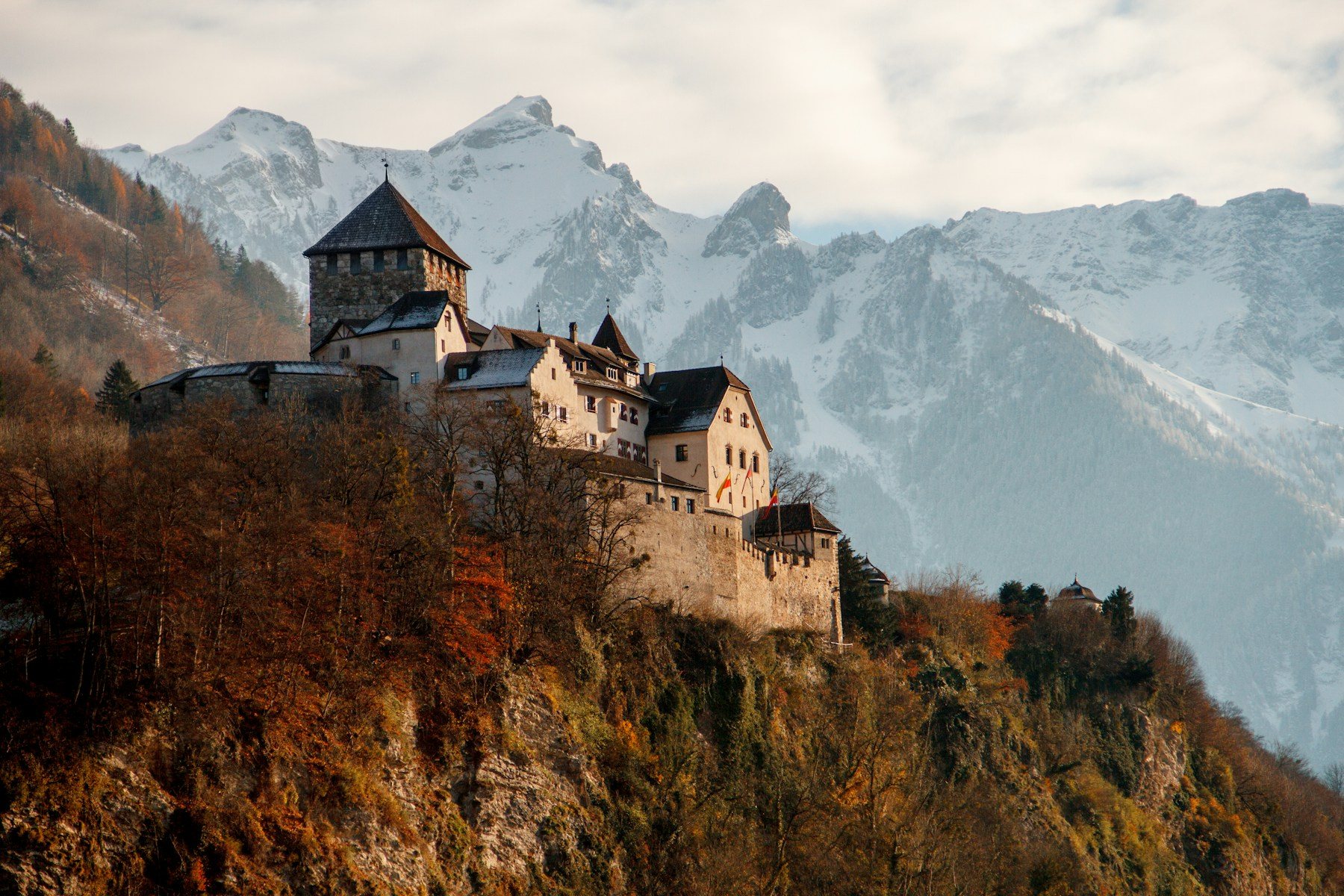
A practical guide to Liechtenstein: how to reach it from Zurich without an airport, what to see in Vaduz, how the money and borders work, and how to fit it into a day or a weekend.
Liechtenstein is a principality of 160.5 square kilometers between Switzerland and Austria, with about 41,237 residents. It is one of only two doubly landlocked countries in the world, meaning every country that borders it is also landlocked. The other is Uzbekistan. The Rhine forms its western border.
For a visitor, that makes for a short, easy trip. The capital Vaduz, the castle above it and the mountains behind are all within a small area, and you can cross the country in an afternoon. The real planning questions are how to arrive, because there is no airport, and how to handle prices, because the Swiss franc and a rich economy make it expensive.
Our short video about Liechtenstein is below. For the quick version of this page, see our Liechtenstein travel guide.
Liechtenstein is a principality led by a prince. Hans-Adam II has been head of state since 1989, and his son Alois acts as regent. The country is divided into eleven municipalities, with Vaduz as the capital. German is spoken by about 92 percent of residents.
The army was abolished in February 1868, and the last soldier died in 1939. The currency is the Swiss franc, and the country has been part of the Schengen area since 2008, so there are no routine border checks with Austria or Switzerland. GDP per capita was about $210,600 in 2024 at purchasing power parity, among the highest in the world.
For travelers that wealth shows up as high prices in restaurants and hotels, and as very clean, well-organized towns. It is a good place for a short stay, and a hard one for a tight budget.
Liechtenstein has no airport. Most visitors fly into Zurich, about 130 kilometers away, or use St. Gallen, about 50 kilometers away. Friedrichshafen in Germany is about 85 kilometers away, and a heliport at Balzers handles private flights.
By rail, a line between Feldkirch in Austria and Buchs in Switzerland has four stations in Liechtenstein, with the S2 service on weekdays. Liechtenstein Bus connects to Buchs and Sargans, which are the usual rail connections on the Swiss side. A common route is to take the train from Zurich to Sargans or Buchs and continue by bus to Vaduz.
Most of what visitors come for is in and around Vaduz.
Because the country is so small, you can see Vaduz in a morning and use the rest of the day for the mountains or a nearby Swiss or Austrian town.
Liechtenstein rises from the Rhine valley at 430 meters to Grauspitz at 2,599 meters, so a short drive takes you into the mountains. Malbun is the ski area, and in summer the same mountains offer walking routes with views across the valley.
If you travel in winter, check the snow reports and the bus timetables before you go, because services and opening hours change with the season. In summer, a day of walking above the valley is an easy complement to a morning in Vaduz.
Our video talks about renting the whole country. The story is real, but it was a promotional stunt. In 2011 a rental listing made headlines by letting a group book all of Liechtenstein for a night, reported at about $70,000, and it was widely covered in the press. It was never a standard product for ordinary travelers.
For a normal trip you only need a normal booking. If you want to hold a large event, the tourism board has a section on conferences and meetings, which is the practical, official route.
The Swiss franc is the currency. In 2023 the country recorded 116,759 arrivals and 222,266 overnight stays, which means an average stay of under two nights. Many visitors come for a day trip from Switzerland or Austria, and that is the cheapest way to see it.
Plan on high prices for food and rooms. If you want to save, stay in a nearby town in Switzerland or Austria and visit Liechtenstein for the day by train and bus.
With about 41,237 residents on 160.5 square kilometers, Liechtenstein has roughly 257 people per square kilometer, so it is more densely settled than you might expect from the mountain scenery, and most people live along the Rhine valley. Eleven municipalities share that space, and public buses link them, which means you rarely need a car once you have arrived.
German is spoken by about 92 percent of residents, and English is usually enough for visitors. The Swiss franc is the currency, so bring a card that works in Switzerland, and check exchange fees if you arrive from the euro area. Because Liechtenstein has been in the Schengen area since 2008, you will not meet a routine border check when you cross from Austria or Switzerland, but you should still carry ID, as rules for your own passport can change.
This is our own suggestion, built from the distances above, not an official itinerary.
Liechtenstein can be visited all year. Summer is the best season for walking and for the views from the castle, and winter suits skiing at Malbun. Opening hours of museums and attractions can differ by season, so check the official tourism pages before you go.
Because the country is small, one day is enough for the highlights. A weekend gives you time for the mountains and a slower pace.
Liechtenstein is best treated as part of a wider trip. Switzerland is to the west across the Rhine and Austria is to the east. Many travelers combine it with Zurich, St. Gallen, Lake Constance or the Austrian town of Feldkirch, which is on the same railway line.
That also helps with costs. Staying in a neighboring town and visiting for the day gives you more choice of rooms and restaurants than staying in Vaduz itself.
Yes. It is a sovereign principality of 160.5 square kilometers between Switzerland and Austria.
No. The nearest major airport is Zurich, about 130 kilometers away. St. Gallen is about 50 kilometers away.
It means every neighboring country is also landlocked. Liechtenstein and Uzbekistan are the only two in the world.
The Swiss franc.
No. The army was abolished in February 1868, and the last soldier died in 1939.
In 2011 a rental listing made headlines by letting a group book it for a night, reported at about $70,000. It was a promotional stunt.
Most people take the train from Zurich to Sargans or Buchs and continue by bus to Vaduz.
One day covers the highlights. A weekend adds time for the mountains.
Liechtenstein is small and expensive, so many visitors stay in Vaduz for the setting, or in nearby Swiss or Austrian towns for the price. Compare prices and reviews, and check the cancellation terms before you reserve.
See stays in Liechtenstein on Booking.com →
Some links on this page are affiliate links. If you book through them, Letsa Atlas may earn a small commission at no extra cost to you.
We checked this guide on November 10, 2026. Prices, timetables and opening hours change, so confirm everything with the official tourism site before you go. Confirm details with official sources before you go.
Sources checked November 10, 2026: Wikipedia: Liechtenstein · TechCrunch: Airbnb rent a country · Liechtenstein Tourism