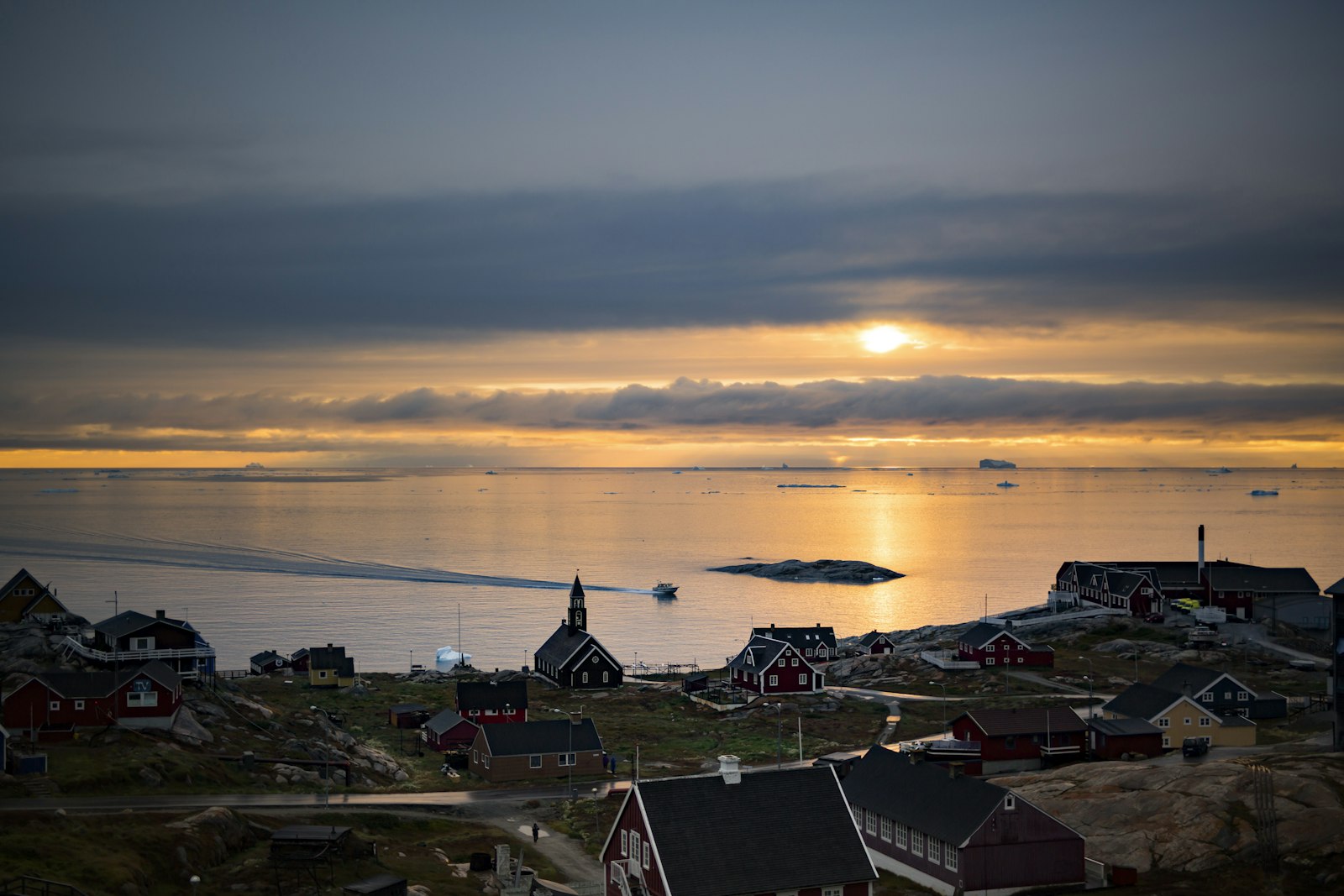
A practical guide to the world's largest island: the main places to visit, the Ilulissat Icefjord, why there are no roads between towns, how to get there, when to go and what it costs.
Greenland is the world's largest island, with an area of about 2.17 million square kilometers and fewer than 57,000 people. It is the least densely populated country in the world. About 81 percent of it is covered by the ice sheet, and over 80 percent of the land mass lies north of the Arctic Circle, so everyone lives on the ice-free coast, most of them on the southwest coast.
It is a self-governing territory of Denmark, outside the EU. Its capital, Nuuk, has about 19,900 residents. The big surprise for visitors is how you get around: there are virtually no roads between towns, so you travel by plane, helicopter and boat.
Our 18-second Short about Greenland is below. For the quick version, see our Greenland travel guide.
The ice sheet covers about 1.76 million square kilometers and holds roughly 2.85 million cubic kilometers of ice. The highest point, Gunnbjørn Fjeld in the Watkins Range, rises 3,700 meters, but most of the island is below 1,500 meters. All towns and settlements are on the ice-free coast.
Greenland has been governed under a Self-Government Act since 2009, which gave it control over many government areas. Denmark keeps foreign affairs, defense, citizenship and monetary policy. Fishing accounts for more than 90 percent of exports, and Danish block grants amount to more than 20 percent of the economy.
That context explains what you see as a visitor. Towns are small and far apart, daily life depends on boats and planes, and the landscape is the main attraction. Highlights include the Ilulissat Icefjord, wildlife such as whales and musk oxen, and long hikes like the 167 km Arctic Circle Trail.
Tourism in Greenland is organized around a few regional hubs. Visitor numbers grew from about 77,000 a year in 2015 to 105,000 in 2019.
| Place | Region | Known for |
|---|---|---|
| Ilulissat | Disko Bay, west coast | The Ilulissat Icefjord, the most popular tourist destination, with iceberg sailing tours |
| Nuuk | Capital region | The capital and largest city, and the international gateway after its airport expansion in 2024 |
| Kangerlussuaq | Arctic Circle | A main international gateway in the past, start of the 167 km Arctic Circle Trail, and a good northern lights spot in winter |
| Qaqortoq | South Greenland | The hub for the south, near Norse ruins such as Hvalsey Church, from about the 12th century |
| Tasiilaq | East Greenland | The main hub of East Greenland |
Typical activities are iceberg sailing, dog sledding, ice cap treks, wildlife and whale watching, and hiking to Norse ruins. The Arctic Circle Trail runs 167 kilometers from Kangerlussuaq to Sisimiut, and a rough 150-kilometer dirt track for all-terrain vehicles opened between the same two places in 2025.
The Ilulissat Icefjord is the best-known sight in Greenland. It runs 40 kilometers west from the ice sheet to Disko Bay, just south of the town of Ilulissat, about 250 kilometers north of the Arctic Circle. It became a UNESCO World Heritage Site in 2004.
The glacier that feeds it, Sermeq Kujalleq, also known as Jakobshavn Isbræ, is described as the most productive glacier in the Northern Hemisphere. It moves roughly 20 to 35 meters per day and sends about 20 billion tonnes of icebergs into the fjord each year. Some icebergs reach about 1 kilometer in height, so tall that they can sit on the shallow fjord bottom for years. The ice in the fjord dates back about 250,000 years, which makes it valuable for studying past climate, and the fast-moving glacier helped advance scientific understanding of human-caused climate change.
Greenland is a place where timing decides what you can do.
Nuuk's average daily temperature ranges from about -5 °C to 10 °C across the seasons. Near the summit of the ice sheet, the lowest temperature ever recorded in the Northern Hemisphere, -69.6 °C, was measured on 22 December 1991.
Greenland has 13 registered civil airports and 43 helipads, most of them unpaved and rural. Nuuk is the international gateway after its 2024 expansion, and Kangerlussuaq was the main gateway before it. Ilulissat has a domestic airport with limited international flights to Iceland, and it is being expanded.
Air Greenland flies from Copenhagen to Kangerlussuaq. From June to September, Icelandair and Air Greenland also fly from Keflavík, which is the easiest and cheapest route from North America. Flights often leave in the morning, so an overnight in Iceland may be needed.
Inside the country there are no roads between settlements, other than a 4.8-kilometer gravel road between Kangilinnguit and Ivittuut and the new all-terrain track. Coastal ferries serve passengers, with one weekly round trip taking 80 hours each way, and Arctic Umiaq Line runs summer passenger ships. Because weather can ground flights, build spare days into any plan, and avoid tight connections with international flights. The same rule applies to boats: the weekly ferry takes 80 hours each way, so it suits travelers with flexible schedules rather than short trips.
Greenland is outside the Schengen Area, and a Schengen visa for Denmark does not cover it. Many visitors can stay up to 90 days without a visa, and a passport valid for three months beyond departure is advised. Entry rules depend on your passport, and national park expeditions need a special permit, so confirm current requirements with the Danish and Greenlandic authorities. Greenland has no border control in the usual sense, but airlines check your documents at check-in, so have your passport ready from the start of the trip.
Greenlandic has been the sole official language since 2009. Danish is still widely used, and English is growing and taught from the first school year. The currency is the Danish krone. Greenland is largely a cash economy, so carry cash as a backup, although every settlement has at least one ATM. Accommodation is expensive, and free camping is possible in open areas.
The emergency number is 112. Crime is very rare. The main danger is cold, so bring warm clothing, and weather can change travel plans quickly. Emergency healthcare is limited in small communities and evacuation is expensive, so get travel insurance. Tap water is drinkable.
This is our own suggestion, not an official itinerary.
Because of the limited transport, trying to cover more than one region in a short trip is usually a mistake. Pick one hub, such as Ilulissat for icebergs, Kangerlussuaq for trekking or Qaqortoq for Norse history, and build the trip around it. Remember that evacuation from remote areas is expensive, which is one more reason to choose guided activities and travel insurance for anything away from towns.
Settlements lie along an ice-free coast of a huge island covered by the ice sheet, so towns are connected by air and sea. Greenland has virtually no roads between towns, only short local roads and a rough 150 km all-terrain track between Kangerlussuaq and Sisimiut that opened in 2025.
Summer brings the midnight sun and the easiest access. Winter is very cold, but Kangerlussuaq is a good northern lights spot.
Greenland is outside the Schengen Area, and a Schengen visa for Denmark does not cover it. Many visitors can stay up to 90 days without a visa, but rules depend on your passport, so confirm with the Danish and Greenlandic authorities.
Air Greenland flies from Copenhagen to Kangerlussuaq. From June to September, Icelandair and Air Greenland also fly from Keflavík, which is the easiest and cheapest route from North America.
The Ilulissat Icefjord, a UNESCO World Heritage Site since 2004, is described as the most popular tourist destination.
The Danish krone. Greenland is largely a cash economy, so carry some cash, although every settlement has at least one ATM.
Accommodation is expensive, and fishing dominates the economy. Free camping is possible in open areas, which is one way to reduce costs.
Crime is very rare. The main risks are cold and weather, and emergency healthcare is limited in small communities, so travel insurance matters.
Ilulissat is the best-known base for icebergs and the Icefjord. Compare prices and reviews, and check the cancellation terms before you reserve.
See stays in Ilulissat on Booking.com →
Some links on this page are affiliate links. If you book through them, Letsa Atlas may earn a small commission at no extra cost to you.
We checked this guide on November 8, 2026. Flights, ferries, entry rules, prices and ice conditions change, and travel in Greenland depends heavily on weather. Confirm details with official sources before you go.
Sources checked November 8, 2026: Wikipedia: Greenland · Wikipedia: Tourism in Greenland · Wikipedia: Ilulissat Icefjord · Visit Greenland