A careful guide to Dallol and the Danakil Depression in Ethiopia: why it is so hot, what the colourful springs are, how tours from Mekele work, the best season, health and safety, and the government advice you must read first.
Many governments warn against travel to northern Ethiopia, including the Danakil Depression, and the security situation can change quickly. Wikivoyage says to visit only on an organised tour with a guide and a military guard, never on your own, and notes that attacks on tourists have happened in the region in the past. There are no warning signs or fences around the pools, and the next hospital is in Mekele, several hours away.
This guide explains the place and how visits have worked. It is not an encouragement to go. Check your own government’s advice and your insurance before considering any trip.
Dallol is a locality in the Afar Region of northern Ethiopia, in the Afar Depression and the Danakil Desert. Wikipedia places it about 130 metres below sea level, and says an average annual temperature of 34.6 °C was recorded from 1960 to 1966, the record high average for an inhabited location on Earth. The highest temperature ever recorded there is 49 °C.
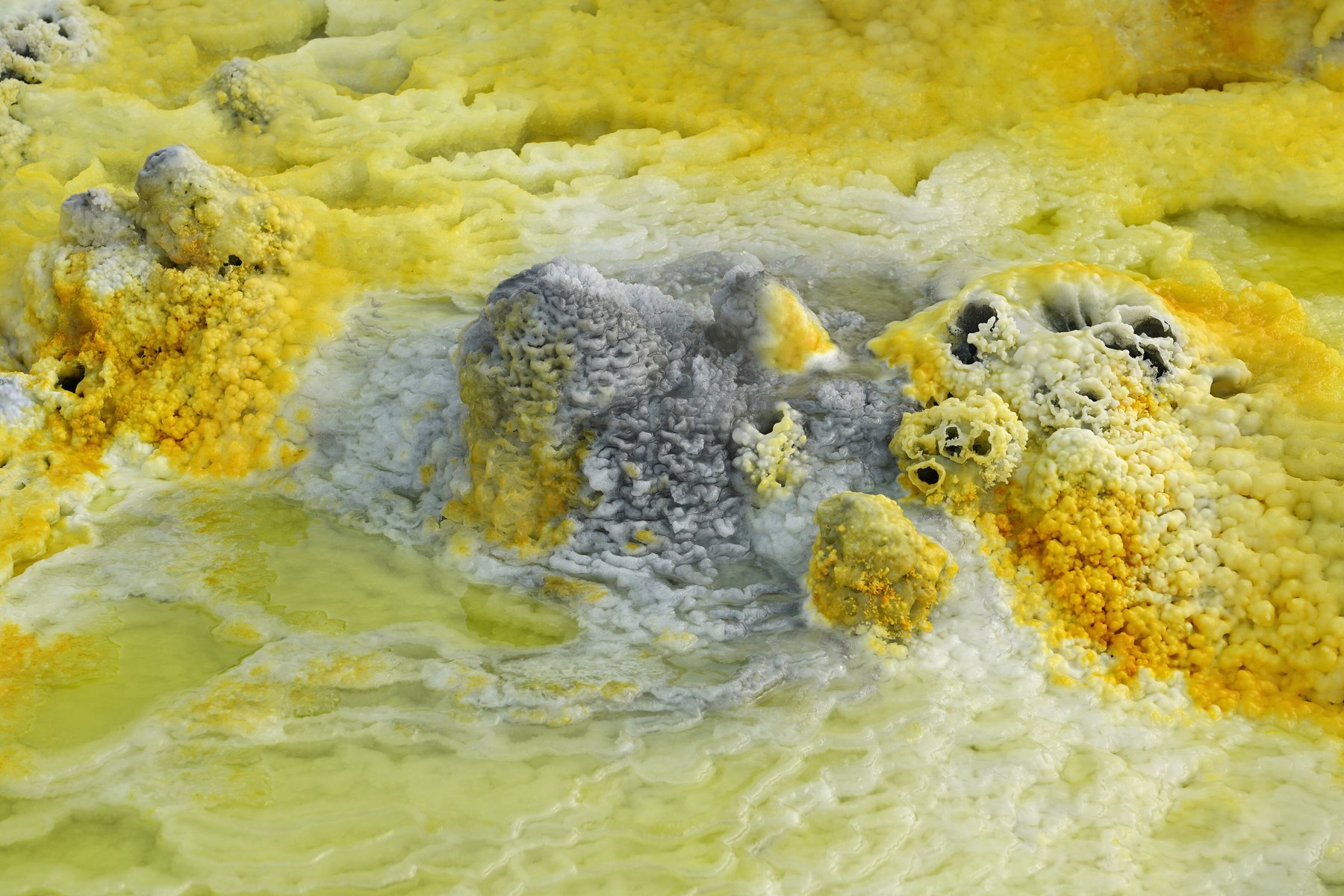
The landscape looks unreal: salt flats, bright yellow, orange and green mineral crusts, and hot springs pushing brine to the surface. Wikipedia describes the area as having a highly active hydrothermal system with springs, terrace systems and fumaroles.
Our 18-second Short about Dallol is below. For the quick version, see our Dallol travel guide.
The land used to be part of the Red Sea. Water flooded in, evaporated and left thick salt deposits behind. Today hot springs push brine up through the salt, and sulfur, iron and other minerals colour it yellow, orange, green and brown. Rain is almost absent, with less than 25 millimetres in an average year according to our source material.
The same minerals that make the pools beautiful make them dangerous. The pond water at Dallol is acidic, so do not touch it, and gases can irritate the lungs. Follow your guide’s instructions exactly about where to walk, because the salt crust can be thin.
Dallol is described as a ghost town. Wikipedia says that as of 2004 some buildings made of salt blocks still stood. The area was mined for potash: between 1925 and 1929 an Italian company mined 25,000 tons of sylvite averaging 70 percent KCl, and by 1965 about 10,000 holes had been drilled at 65 locations. Potash production reportedly reached about 51,000 metric tons after a railway was built.
The Afar people still cut salt slabs by hand in the region, and camel caravans carry them up toward the highlands. That tradition is one of the most striking parts of a visit, but it is working life, not a performance, so be respectful when taking photographs.
Tours usually start in Mekele, which has an airport. From Mekele it is about three hours by road to Berhale, the closest village. From Berhale a dirt track leads to Hamad-Ela, a base camp for Dallol, and then a short walk from the salt crust of Lake Karum to the sulfur springs. Tours run two, three or four days, and some leave from Addis Ababa with a flight into Mekele.
Facilities are basic. Expect sleeping on mattresses or under the stars, simple food and long drives on rough tracks. Because operators and security conditions can change, confirm every detail directly with a licensed operator.
Our source notes list the main sights:
Which of these are included depends on the tour and on security conditions, so ask the operator before you book.
November to February is the main season, when the shade is around 30 °C. The rest of the year it is extremely hot, close to 50 °C at the peak. Even in the cooler months, the sun is intense and there is almost no shade, so bring a lot of water, sun protection and light, long-sleeved clothing.
The main risks are heat, dehydration, sun exposure and gases near the springs. Drink more water than you think you need, wear a hat and sunglasses, and listen to your guide. Medical care is far away, so carry a first-aid kit, take any personal medication, and make sure your insurance covers evacuation. Ask a travel clinic for advice on vaccines and other health precautions before you go.
Dallol sits inside the Danakil Depression, which Wikipedia describes as about 200 by 50 kilometres across the north of Ethiopia’s Afar Region and Eritrea. It is the third-lowest point in Africa, at about 125 metres below sea level according to the article’s introduction, although a later section gives 100 metres, which is why sources vary between roughly 92 and 130 metres.
The depression forms where the Nubian and Danakil plates pull apart, at about 18 millimetres a year in the south and 8 millimetres in the north. Rifting began about 11 million years ago. Volcanoes in the southern range include Erta Ale, and to the north lie Maraho and Dallol. Lakes such as Afdera, Karum and Bakili are saline lakes with no outlet to the sea.
Beneath it all are evaporite deposits more than 500 metres thick, mainly halite with potash minerals in the lower part. Dallol itself is a salt volcano with extremely acidic, salty and hot fluids. Microorganisms live in most of its ponds, but not near the hottest chimneys. The Gaet’ale Pond has about 43 percent salinity and is described as the saltiest water body on Earth. In 2022 the IUGS included the area in its list of 100 geological heritage sites.
The Afar people live and work here, and the salt trade is their livelihood. Ask before photographing people, do not hand out sweets or money to children, and follow your guide’s advice on local customs. Stay on marked paths, since the mineral crusts are fragile and the chemistry is hazardous. Take all your rubbish out with you.
This is our own outline of how tours are often structured, not an official itinerary.
Always allow extra days in case of security, weather or transport changes.
It lies about 130 metres below sea level in a desert depression. Wikipedia reports an average annual temperature of 34.6 °C from 1960 to 1966, the highest recorded for an inhabited location.
Hot springs push brine through salt deposits, and sulfur, iron and other minerals colour the surface yellow, orange, green and brown.
Many governments warn against travel to northern Ethiopia, including the Danakil. Wikivoyage says to visit only with an organised tour, a guide and a military guard.
November to February, when the shade is around 30 °C. The rest of the year is extremely hot.
Tours usually start in Mekele, about three hours by road to Berhale, then a dirt track to the base camp at Hamad-Ela.
No. The pond water at Dallol is acidic. Follow your guide’s instructions.
Yes. Wikipedia describes Dallol as a ghost town, with some salt-block buildings still standing as of 2004.
An active volcano with a lava lake, usually visited as a separate overnight hike.
Wikipedia describes the Gaet’ale Pond in the Danakil Depression as the saltiest water body on Earth, with about 43 percent salinity. Do not touch any of the pools.
We checked this guide on November 8, 2026. Many governments warn against travel to northern Ethiopia, including the Danakil, and the security situation can change quickly. Read your own government’s advice first, and do not go without a licensed operator, a guide and an armed escort. Confirm details with official sources before you go.
Sources checked November 8, 2026: Wikipedia: Dallol, Ethiopia · Wikipedia: Danakil Depression · Wikivoyage: Danakil Depression · Wikivoyage: Ethiopia (security warning)