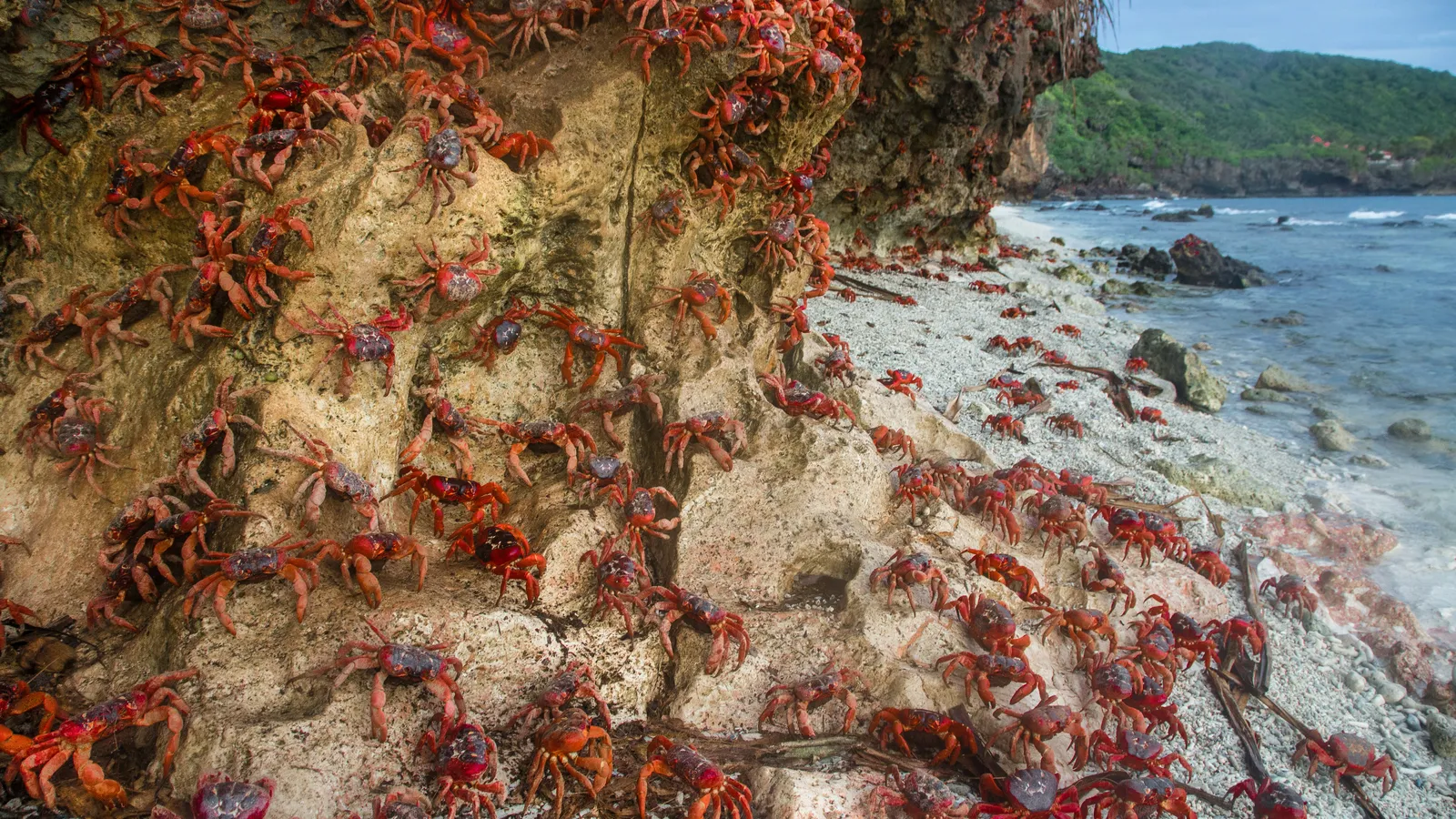
How the migration works
For most of the year, red crabs stay in the damp rainforest on the island's central plateau. The first heavy rains of the wet season set them moving. Males reach the shore terraces first and dig burrows, females follow, and mating takes place about two weeks before spawning.
Females then wait in the burrows while their eggs develop. One crab can carry up to 100,000 eggs. Around the moon's last quarter, before dawn and as the high tide turns, they crowd the water's edge and release the eggs into the sea. Weeks later, tiny crabs that survived the fish, manta rays and whale sharks come ashore and spend about nine days climbing back to the forest.
When to go
Parks Australia says the migration starts with the first rains, usually in October or November, though it can be as late as December or January. The island's tourism association publishes predicted spawning dates each season, and spawning can be pushed back by one lunar month if the rain is late. Plan around those dates, and keep some flexibility, because no one can promise exactly when the crabs will move.
Where to watch
Drumsite, Flying Fish Cove, Ethel Beach and Greta Beach are among the easiest places to see crabs on the move or spawning. The crab bridges over the main roads are good spots to watch them cross. Elsewhere, any shore where crabs can reach the ocean may fill up during spawning mornings.
Roads and crab bridges
Road closures are expected every year during the migration. Some sections close for part or all of the day at peak times, often at short notice, and updates appear on the Christmas Island Road Access Board, public notice boards and local radio. Before the crabs move, park staff install barriers that guide them into underpasses and onto steel crab bridges. Locals often carry rakes or leaf blowers to gently clear crabs from the road.
Why the numbers doubled
Invasive yellow crazy ants have killed tens of millions of red crabs. To fight them, park staff released a tiny wasp that attacks an insect the ants depend on for food. Reports in November 2026 said the red crab population has roughly doubled in about five years, from around 50 million to more than 100 million.
Beyond the crabs
About 63% of Christmas Island is national park. The Dales, on the western side, is a rainforest area with seven deep valleys and the popular Hugh's Dale waterfall. The island is famous for seabirds, including the Christmas frigatebird and the golden bosun, a local subspecies of the white-tailed tropicbird, and for robber crabs, the world's largest land crabs. Snorkelling and diving on the fringing reef are other reasons to stay a few days.
Getting there
The island has one airport, and flights come from Perth. Virgin Australia stopped serving the island in November 2025, and Qantas (QantasLink) now flies the route. The island's tourism site lists flights on Mondays and Fridays, with some services stopping on the Cocos (Keeling) Islands. Direct flights take about 3.5 to 4 hours. Seats are limited and extra flights are sometimes added in peak season, so check the airline's current schedule early.
Getting around
There is no public transport, so most visitors rent a car and book it together with their room. Australia drives on the left. During the migration, drive slowly, steer around crabs only when it is safe, and expect to park and walk when roads are closed.
Tips and etiquette
- Watch your step: walk slowly and carefully among the crabs, and never pick them up.
- Respect closures: closed roads protect millions of crabs, so follow the signs and barriers.
- Bring cash: travel sites report there is no ATM on the island, so carry Australian dollars.
- Pack your carry-on well: luggage on small island flights is sometimes left behind for weight, so keep medicines and essentials with you.
- Mind quarantine: the island protects unique wildlife, so check what you can and cannot bring.
Entering Australia
Christmas Island is an Australian external territory, so Australian entry rules apply. Most visitors who are not Australian or New Zealand citizens need a visa or an Electronic Travel Authority (ETA) before they fly to Australia. The flight from Perth is a domestic-style trip, but bring your passport. Check the official Australian government requirements for your nationality before you book.
A 4-day plan
This is our own suggestion, not an official itinerary.
- Day 1: land, pick up your car and visit the crab bridges and roads around Drumsite and The Settlement.
- Day 2: spend the morning at Ethel Beach or Greta Beach, then walk to The Dales and Hugh's Dale waterfall.
- Day 3: on a predicted spawning morning, be at the shore before dawn; later, look for frigatebirds and the golden bosun.
- Day 4: snorkel at Flying Fish Cove, look for robber crabs, then catch your flight back to Perth.
Frequently asked questions
When is the red crab migration on Christmas Island?
The migration starts with the first heavy rains of the wet season, usually in October or November, and Parks Australia says it can sometimes be as late as December or January. In 2026, crabs began moving on November 14 and 15. The whole cycle, from the march to the sea to baby crabs returning, runs over several weeks between October and February.
How many red crabs live on Christmas Island?
The island's tourism association estimates more than 100 million red crabs. Reports in November 2026 said the population has roughly doubled in about five years, from around 50 million, after work to control invasive yellow crazy ants.
Why do the red crabs migrate?
Adult red crabs live in the rainforest on the island's plateau. To breed, they march to the coast, where males dig burrows and mating takes place. Females then release their eggs into the sea before dawn on a receding high tide around the moon's last quarter, and the young crabs later return to the forest.
Where can I see the red crab migration?
Drumsite, Flying Fish Cove, Ethel Beach and Greta Beach are among the easiest places to watch, along with the crab bridges and underpasses built over and under the roads. Crabs can reach any shore where they have access to the ocean.
Are roads closed during the crab migration?
Yes. Parks Australia expects road closures every year during the migration, and some sections close for part or all of the day at short notice. The Christmas Island Road Access Board publishes updates, and the park sets up barriers, underpasses and crab bridges before the crabs move.
Is Christmas Island part of Australia?
Yes. Christmas Island is an Australian external territory in the Indian Ocean. It was transferred to Australia from Singapore on October 1, 1958. It lies about 2,600 km northwest of Perth and roughly 350 km south of Java.
How do you get to Christmas Island?
Flights leave from Perth in Western Australia. Since late 2025 the route has been flown by Qantas (QantasLink), and the island's tourism site lists flights on Mondays and Fridays, some via the Cocos (Keeling) Islands. Direct flights take about 3.5 to 4 hours. Check the airline for the current schedule before you plan.
Do I need a visa to visit Christmas Island?
Christmas Island is part of Australia, so Australian entry rules apply. Most visitors who are not Australian or New Zealand citizens need an Australian visa or Electronic Travel Authority (ETA) before they travel. Check the official Australian government requirements for your passport.
Why is it called Christmas Island?
Captain William Mynors of the East India Company named it after sailing past on Christmas Day in 1643.
What else is there to do on Christmas Island?
About 63% of the island is national park. Visitors come for rainforest walks such as The Dales and Hugh's Dale waterfall, seabirds including frigatebirds and the golden bosun, robber crabs, snorkelling and diving around the fringing reef, and in some seasons whale sharks offshore.